Showing posts with label Orientalia. Show all posts

Monday, August 31, 2009

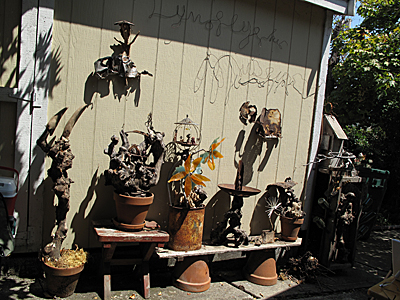
The Garden of the Four Monks


The Museum's forecourt has gotten a major upgrade this summer, inspired by a generous grant of rusty materials, woody scraps, and other curiosa from Neva Beach. One may be forgiven for picturing Neva Beach as a pleasant shoreside locale where one can find treasures from the sea, and this is, in a sense, true, but Neva, properly speaking, is a person, not a place.
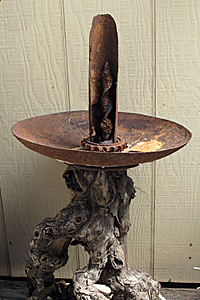


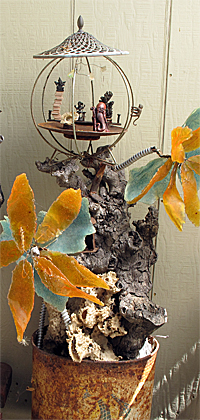
The xeriscape gardening against the museum's front wall is based on some gnarled stumps and includes of a number of strange plants endemic to the Zymoglyphic Isles, including land sponges (zoophytes, in fact, not plants at all) and the legendary Giant Rust Flower. This last flowers only once in its lifetime, but spectacularly, a huge colorful bloom; the flower then rusts in place, decaying slowly thereafter. Other plants derive their drought tolerance from metallic and plastic components.


The theme for the landscaping is the legend of the four Zymoglyphic monks, a tale from the Era of Oriental Influence. An ancient tradition holds that enlightenment can be sought in the study of nature and natural forces, especially rust. According to the tale, each monk set out to seek enlightenment, but as is so often the case, different schools of thought prevailed.
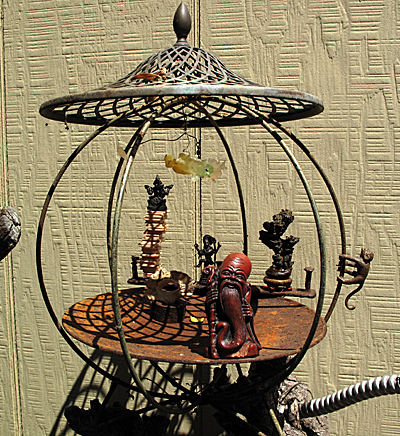


The Scholar Monk maintains a well-stocked library, surrounding himself with the writings of the great minds and kindred souls of the ages. He studies and reflects on them, compiles, analyzes, and synthesizes his research. He collects art and significant objects for inspiration (a favorite viewing stone, a copper nodule, is currently on display). He has staked out a breezy top-floor aerie in one of the garden plants, and installed a mobile that makes the wind visible. A little monkey comes to visit sometimes to remind him to get his nose out of his books and reconnect with nature.
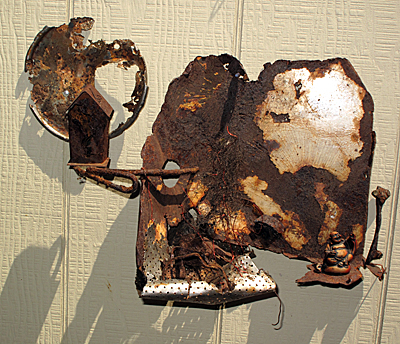
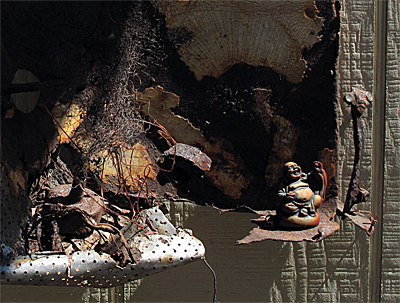


The Rust Monk is less interested than the Scholar Monk in what other people have said and done. He wants to find his own unique way, unencumbered by the past, listening to an inner voice. He seeks enlightenment from his creative expression, to express things that cannot be said in words. He has collected a number of rusty objects and assembled them to create a complex living environment. His creation floats above the garden, not rooted in any part of it.
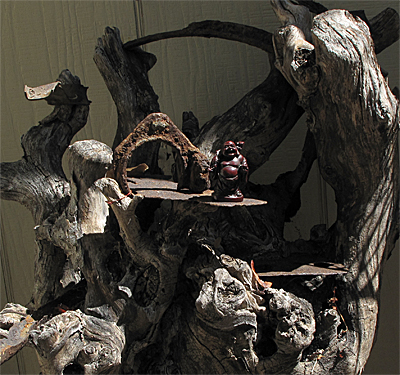


The Wandering Monk has decided to rid himself of the distractions of possessions, collections, books, and art, no matter how pure or ennobling they may be. He has kept only a bag full of necessities and set off to wander in the wilderness, savoring the freedom of the adventure, to see what nature and rust can teach him. In the twists and turns of the thick branches of an ancient stumpy tree, he has found a rusty viewpoint from which to view the passing scene and get some perspective on the world. He will soon be moving on in his restless quest.
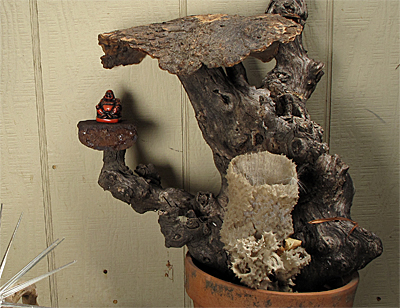


The Shelter Monk is a sort of hermit. Like the Wandering Monk, he has cast away his possessions, but he is content with a simple place to sit in quiet, inward contemplation, sheltered from the buffeting environment. He believes that each part of the universe contains the whole and one need only stay in one place and fully experience it to attain the sought-after enlightenment. It is not necessary to go from one place to another. He has found his spot on a flap of rust, under a wide natural shelter, and he plans to stay there.
Wednesday, December 31, 2008

A Photogenic Metal Viewing Stone


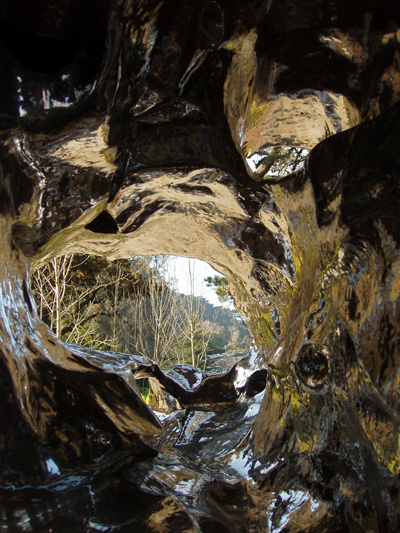
Zhan Wang is a Chinese sculptor who has created a number of metal viewing stones in stainless steel, titled simply "Artificial Rock". He makes them by forming stainless steel over a selected rock, peeling away the metal, assembling the pieces into a hollow copy of the original stone, and polishing to a reflective shine. The result combines the complex forms and organic textures of the original stone with the sleek modernity of chrome.

Most of the artificial stones are one or two feet high, but there is one of monumental size in the de Young Museum's sculpture garden. Taking close-up photographs of the stone creates a sort of "found art". The rough texture creates a vertiginous funhouse mirror effect and, with no color of its own, the surface takes on the colors of the surrounding environment. Green patches are the reflection of surrounding vegetation, blue pools come from the sky, and the dark areas are shadows, often the photographer's own.

Zhan Wang has created his own series of similar photographs, an example of which can be found here.

Sunday, February 24, 2008

Penjing - Chinese Landscapes in a Tray


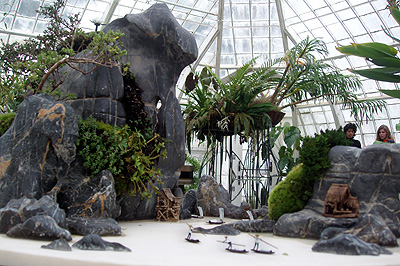
Penjing are small dioramas that depict idyllic scenes in a tray using stones and living plants, carefully selected and arranged for the desired effect. The art form dates back at least 1300 years in China. Tree penjing was a style that showcased miniature trees, an art form familiar today as bonsai. Landscape penjing is another variety that creates three-dimensional versions of the idealized landscapes depicted in traditional Chinese painting. The stones used are selected for texture and form that represent in miniature a fantastic geology of caverns and dizzying vertical drops. Plants are added to make the arrangement come alive. The scenes are populated only by the occasional hut and the little boats that wend their way through the landscape.

An exhibit of ten landscape penjing is currently on view in the aquatic plant room of the Conservatory of Flowers, the big Victorian greenhouse in San Francisco's Golden Gate Park. They will be there until April 27, 2008. The photograph above is closeup of one of them and others can be seen at Flickr.

Tray landscapes were popular during the Zymoglyphic Era of Oriental Influence. The only one currently in the museum's collection shows more of an emphasis on whimsical, rather than idyllic, theme and the use of strange dried stuff in place of stones and living plants.

An excellent book on penjing is
Penjing: Worlds of Wonderment: A Journey Exploring an Ancient Chinese Art and Its History, Cultural Background, and Aesthetics. The associated Web site is here

The Conservatory show was reviewed in the San Francisco Chronicle

Previous Web log entries on oriental nature-based arts:
Chinese root carving
Ikebana - Japanese Flower Arranging

Sunday, November 11, 2007

Chinese Root Carving


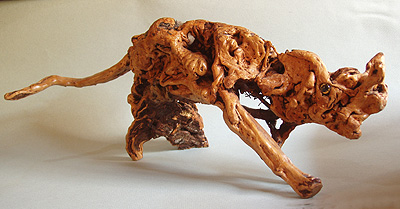
The Zymoglyphic Museum's Department of Special Collections has recently acquired for its curiosity cabinet this fine example of a root carving, a folk art tradition that goes back at least 2,000 years in China. Root carving is one of a number of Chinese and Japanese arts based on creating art from nature, with the focus on the natural characteristics of the object. We have previously covered ikebana, the Japanese art of arranging natural objects, and viewing stones, or scholar's rocks, which are complex stones presented for contemplation.
In this root carving, the anonymous artist has created an image not of a specific animal, but a dynamic creature of the imagination, full of life force, complete with hints of bones, sinews, musculature, and body cavities, all done through simple but effective highlighting of the natural features of the selected object.
A related folk art form is the carving of bamboo root, whose whiskery texture lends itself well to making intriguing masks. The museum has recently acquired an example of one of these masks, made by a member of the Tamang tribe of Nepal.

Sunday, March 18, 2007

Ikebana: An Ancient and Modern Natural Art from Japan


I went up to San Francisco last weekend to see the biennial Ikebana Flower Show in Golden Gate Park. Ikebana originated some five hundred years ago in medieval Japan as a spiritual expression of natural energies, often in association with Zen Buddhism. It is primarily a formal arrangement of flowers, branches, and a variety of other objects, usually placed on a stand or in a vase. Ikebana can celebrate any season, but it is at its best as celebration of the rebirth of nature in spring.

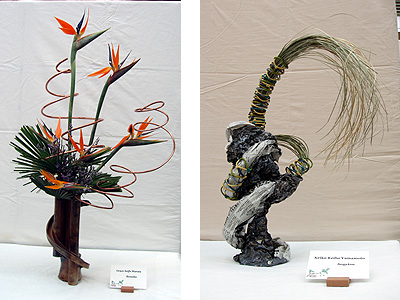
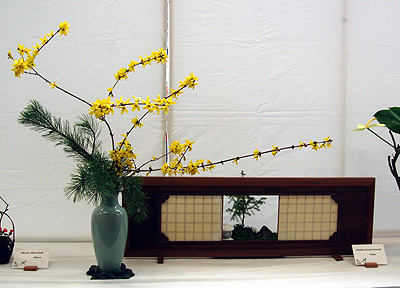
Both ancient and modern approaches were represented in the show. The arrangement at the top left, by Grace Murata, is in the Ikenobo style, a traditional school which dates back to the 15th century and emphasizes formal training. On the upper right is a more modern version from Keiko Yamamoto using hair clips and wadded up newspaper, in the Sogetsu style. Sogetsu is a school founded in 1927 which encompasses a broad range of styles, including free form and avante-garde, and invites participation by anyone. The lower arrangement, by Michiko Hosada, is an example of the Chiko school, which can include architectural elements, figures, and other objects to create symbolic landscapes. Examples from some of the many other schools of ikebana can be seen here and here.

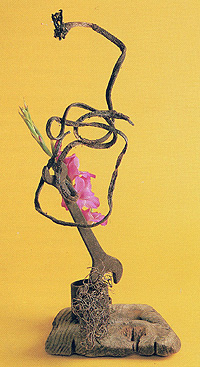
Ikebana is much like Zymoglyphic art, especially that of the Era of Oriental Influence. Both are based on the assemblage of (mostly) natural objects, selected, arranged, and composed for a poetic effect, and placed in some framing context, such as a stand or a decorative vase. Both aspire to be something more than simple decoration. An ikebana arragment, such as the one shown below, may contain materials familiar to fans of Zymoglyphic art, such as dried fungus, mossy branches, gnarled driftwood, wire, seaweed, or rusty objects (although we are unaware of any ikebana containing dead animals). The focus on fresh flowers usually makes ikebana a more evanescent art than a typical Zymoglyphic artist would prefer, needing to be constantly renewed and redone, surviving only in pictures and memories. The museum's curiosity cabinet contains an example of a more durable ikebana arrangement, acquired at the 1998 ikebana show.


A good introduction to ikebana, focusing on the wide-ranging Sogetsu school, is Ikebana: A Practical and Philosophical Guide to Japanese Flower Arranging The image here is taken from that book.