Sunday, November 11, 2007

Chinese Root Carving


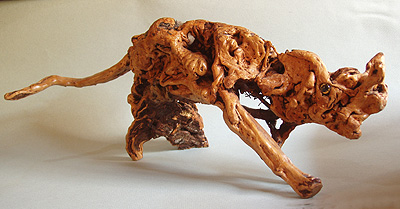
The Zymoglyphic Museum's Department of Special Collections has recently acquired for its curiosity cabinet this fine example of a root carving, a folk art tradition that goes back at least 2,000 years in China. Root carving is one of a number of Chinese and Japanese arts based on creating art from nature, with the focus on the natural characteristics of the object. We have previously covered ikebana, the Japanese art of arranging natural objects, and viewing stones, or scholar's rocks, which are complex stones presented for contemplation.
In this root carving, the anonymous artist has created an image not of a specific animal, but a dynamic creature of the imagination, full of life force, complete with hints of bones, sinews, musculature, and body cavities, all done through simple but effective highlighting of the natural features of the selected object.
A related folk art form is the carving of bamboo root, whose whiskery texture lends itself well to making intriguing masks. The museum has recently acquired an example of one of these masks, made by a member of the Tamang tribe of Nepal.

Saturday, August 11, 2007

The Rainbow Jewel from Another Planet


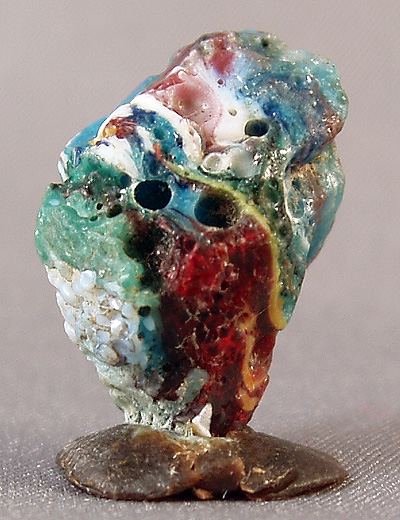
The object shown above is the Zymoglyphic Museum's acquisition number 1. According to legend, this mysterious object came to the Zymoglyphic region from another planet, carrying within it the seed of the museum.


My boyhood museum, was, like most modern museums, primarily dedicated to a fairly literal, scientific view of the world. I wanted to identify things accurately and categorize them correctly. However, this particular object is one of a couple of items in that original museum that were relics of an earlier, more fanciful, era. inspired by Superman's museum in his Fortress of Solitude. His museum included an alien zoo, souvenirs of his exploits and his trips to exotic places, and, most interesting to me, an entire city in a bottle, which may have been the inspiration for the creation of the Zymoglyphic dioramas many years later. Normally a very private space, Superman's museum was, like the Zymoglyphic Museum, open to visitors on occasion. In this story from Action Comics #261 (July, 1958), he brings the entire fortress to Metropolis so people can tour it.


One item that I had in my original museum was a bar of some kind of metal that was much softer than it looked. I bent it into an "S" shape and pretended that it was something that Superman himself might have created and displayed as a museum exhibit. The other was this small, multicolored chunk of melted material that I imagined was some sort of mysterious extraterrestrial artifact, possibly related to the "rainbow jewel from another planet" in Superman's museum. The "S" bar is long lost, but the rainbow jewel has survived through the years and is now on view in the Zymoglyphic Museum atop its own little pedestal, framed in the style of a viewing stone, .

Sunday, August 05, 2007

Open Studios Report


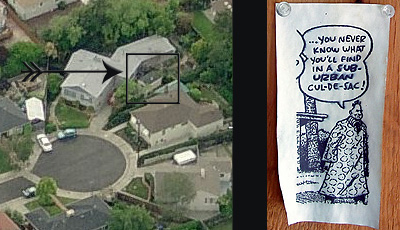
The curator's web log is finally being resuscitated after withering in a prolonged summer drought. The open studios event for 2007 provided an idyllic interlude for visitors to sample both the museum and the books and metalwork of Judith Hoffman. Photographs of the festivities have been posted to the museum's Flickr account, providing long-awaited proof that the museum does truly exist as a physical entity and not just as a Web site. In fact, the museum is now visible from space, or at least somewhere in that general direction, as shown above (with commentary by Zippy the Pinhead).

The museum's landscaping program was completed in time for the event. The ecological landscape design uses recycled materials and provides a lively counterpoint to the otherwise bland exterior of the museum. A skilled team of spiders maintains the zymoglyphic nature of the landscaping by connecting various parts with webs and capturing random debris in them.

The museum shop reported a 100% increase in its customer base during the event. This singular feat was accomplished by selling a mug to museum colleague and noted L.A. art critic Peter Frank. In the ensuing confusion, museum management failed to obtain from Mr. Frank any sort of trenchant aesthetic analysis of the mug's postmodern, self-referential qualities, perhaps even addressing whether the mug is itself a work of art, and the act of buying one an act of performance art.

The opening also inaugurated the museum's Cafe Ruste, a small shop designed to accommodate customers who are less than three inches tall.

Friday, May 04, 2007

Museum to be Open to the Public May 19th and 20th!

The Zymoglyphic Museum will have its annual weekend of being open to the public on May 19th and 20th as part of Silicon Valley Open Studios! This is a rare chance to see the exhibits in person. Especially recommended are the dioramas, which are difficult to present adequately in photographs.

Previous visitors will be pleased to note that there have been a number of new acquisitions in the last year, including a new diorama and the copper scrolls. If you haven't attended this event in a while, you can see the full list of what's new here.

Also on site will be the delectable metalwork and artist's books of Judith Hoffman

You may wish to make your visit part of a more comprehensive tour of the Peninsula's Open Studios. Tour maps will be available at the museum.

That modern celebration of mechanical wonders known as the Maker Faire is the same weekend and visitors in town for it should note that the Zymoglyphic Museum is located less than 20 short blocks to the south. If you are visiting the Faire, be sure to make the museum a part of your day!

Directions here

Sunday, April 29, 2007

New Diorama: Dream House


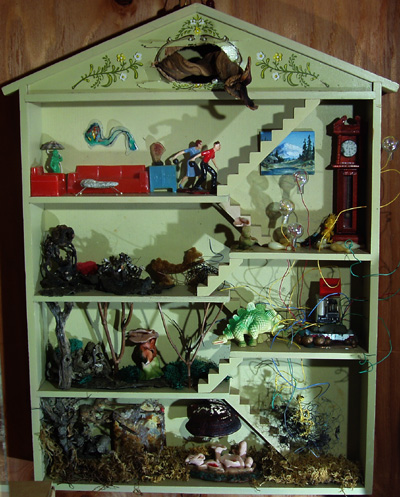
The Zymoglyphic Museum has just added a new diorama in an unusual style. Zymoglyphic dioramas are most frequently constructed in fish tanks or vitrines; this one uses an old display case to show a modern couple connecting to their "roots" in a most literal sense. For another view of domesticity in a diorama, see The Quiet Parlor of the Fishes

Saturday, April 21, 2007

Museum Shop Financial Report and Price Cut

Our accountants have finally gotten around to tabulating and analyzing the vast lack of sales in the museum shop for fiscal year 2006. Since we cannot use any positive integers to describe the sales figures, we are looking into the feasibility of utilizing transcendental or imaginary numbers instead. Our statisticians remain stymied by the necessity of having to divide by zero.

Our marketing department recently convened a focus group consisting of the shop's entire customer base to review our offerings. In accordance with the group's findings, we have added a number of fine items to our once meager product line, including a mousepad and bumper stickers. As always, rebellious young ladies (and their suitors) should take particular note of our "thong" undergarments featuring the controversial and possibly inappropriate "flying dead mouse" design.

Our outside marketing consultant, Harry "The Axe" Warbler, suggested that we "cut prices down to the jugular vein!!" and proclaim "we've lost our heads!!!." His proposed accompanying visuals, while undeniably edgy and eye-catching, were rejected by the good taste committee as unnecessarily graphic. However, we are pleased to announce that prices have indeed been reduced and are now so low we would need to consider cash incentives to convince potential customers to avail themselves of our merchandise. Harry suggests, possibly sarcastically, that perhaps our slogan should be "Please be sure to take advantage of the situation before our peripatetic cephalic appendages are located and properly reattached."

Sunday, April 08, 2007

Zymoglyphic Alchemy: Copper Scrolls


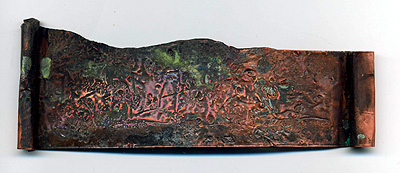
The Zymoglyphic Museum has added a significant new collection to its Rust Age holdings - a set of copper scrolls depicting the mythical Primordial Ooze. During the Rust Age, most artifacts were constructed using naturally weathered materials, whether rusty metal or partially decayed organic matter. However, there were attempts by early Zymoglyphic alchemists to reproduce these effects artificially, a collaboration of art and nature (following, as always, the dictum "Let nature do the detail work").

European alchemists had a goal to transform base metals, such as copper, which were subject to corruption through natural oxidation, into pure gold, which was incorruptible and did not tarnish or weather. Zymoglyphic alchemists were more interested in maximizing the corruption of the base metal; purity was seen a sort of bland homogeneity. The Zymoglyphic ideal was to transform something relatively pure, such as a sheet of copper, into something more complex and interesting. Alchemists in both cultures sought to release "spirit in matter" through the symbolic dissolution of metal and creation of its fermentation byproducts.

Zymoglyphic alchemists used many of the same chemicals on their copper that their European counterparts used to transform metal - blue vitriol (copper sulfate), sal ammoniac (ammonium chloride), liver of sulfur, and common salt, as well as biologically derived fluids such as vinegar and urine. By applying this process to scrolls of sheet copper, they produced pre-literate "books" that told the story of the creative ferment in the primordial ooze. During the Zymoglyphic Age of Wonder, alchemists focused more on metaphysical transformations, rather than chemical ones, as can be seen in this alchemical apparatus from that era.

Copper has been valued throughout Zymoglyphic history. It is one of the very few metals besides gold (and iron meteorites) to be found naturally in pure metallic form. Copper ores can be very attractive, particularly green malachite and and its brilliant blue relative, azurite. Both are chemically closely related to copper patina, or verdigris. The museum has a particularly nice specimen of malachite which was mounted as a viewing stone during the Era of Oriental Influence. A mineral specimen containing both malachite and azurite was incorporated into the Age of Wonder's small cabinet of wonders, and a complex nodule of metallic copper is on display as a miniature sculpture in one of the Modern Era's shoebox art galleries.

Some further references on historical alchemy:

The Golden Game: Alchemical Engravings of the Seventeenth Century A coffee-table size book focused on the visual imagery of alchemy

Alchemy & Mysticism: The Hermetic Museum (Klotz) Primarily imagery, organized by concept

Psychology and Alchemy Carl Jung's take on the symbolism of alchemy as personal transformation

The Forge and the Crucible: The Origins and Structure of Alchemy Alchemy's origins in metallurgical and mining mythology

The Alchemy Web Site

For pictures of copper ores, see Molly Holzschlag's Mineral Art Flickr set

Sunday, March 18, 2007

Ikebana: An Ancient and Modern Natural Art from Japan


I went up to San Francisco last weekend to see the biennial Ikebana Flower Show in Golden Gate Park. Ikebana originated some five hundred years ago in medieval Japan as a spiritual expression of natural energies, often in association with Zen Buddhism. It is primarily a formal arrangement of flowers, branches, and a variety of other objects, usually placed on a stand or in a vase. Ikebana can celebrate any season, but it is at its best as celebration of the rebirth of nature in spring.

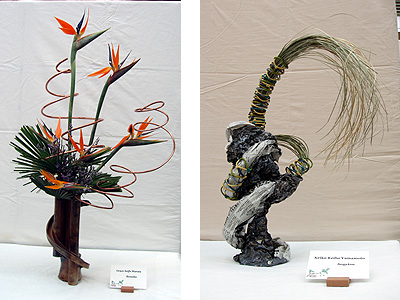
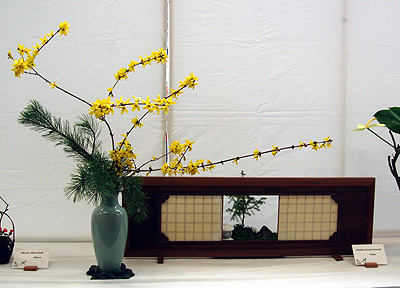
Both ancient and modern approaches were represented in the show. The arrangement at the top left, by Grace Murata, is in the Ikenobo style, a traditional school which dates back to the 15th century and emphasizes formal training. On the upper right is a more modern version from Keiko Yamamoto using hair clips and wadded up newspaper, in the Sogetsu style. Sogetsu is a school founded in 1927 which encompasses a broad range of styles, including free form and avante-garde, and invites participation by anyone. The lower arrangement, by Michiko Hosada, is an example of the Chiko school, which can include architectural elements, figures, and other objects to create symbolic landscapes. Examples from some of the many other schools of ikebana can be seen here and here.

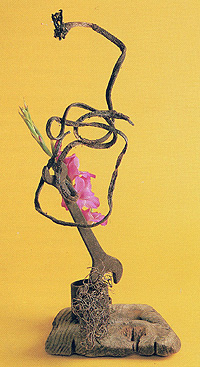
Ikebana is much like Zymoglyphic art, especially that of the Era of Oriental Influence. Both are based on the assemblage of (mostly) natural objects, selected, arranged, and composed for a poetic effect, and placed in some framing context, such as a stand or a decorative vase. Both aspire to be something more than simple decoration. An ikebana arragment, such as the one shown below, may contain materials familiar to fans of Zymoglyphic art, such as dried fungus, mossy branches, gnarled driftwood, wire, seaweed, or rusty objects (although we are unaware of any ikebana containing dead animals). The focus on fresh flowers usually makes ikebana a more evanescent art than a typical Zymoglyphic artist would prefer, needing to be constantly renewed and redone, surviving only in pictures and memories. The museum's curiosity cabinet contains an example of a more durable ikebana arrangement, acquired at the 1998 ikebana show.


A good introduction to ikebana, focusing on the wide-ranging Sogetsu school, is Ikebana: A Practical and Philosophical Guide to Japanese Flower Arranging The image here is taken from that book.

Friday, March 09, 2007

New Online Exhibit: Baroque Museum Tour


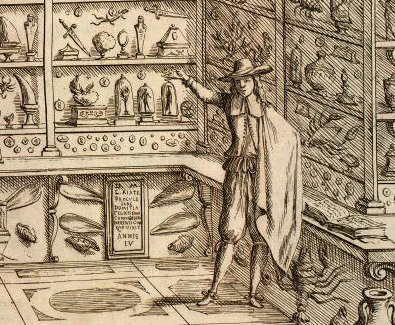
Our esteemed cyberpatrons are welcome to take a virtual tour of six personal museums from Europe's Baroque era. One of them, Athanasius Kircher's museum, was featured here recently. Above, Ferdinando Cospi beckons across the centuries and invites us to pore over his collection of lizards, things in jars, sealife, figurines, weaponry and objects of all kinds.
These personal museums may be considered early forerunners of the Zymoglyphic Museum, sharing a goal of collecting wonders rather than instructing the public in literal facts. While they reflected the personal interests of their creators, these early museums contained enough variety to create within their walls a microcosm of the world.

Saturday, February 10, 2007

Athanasius Kircher's Museum in Rome


Athanasius Kircher was a 17th century Jesuit scholar, and studied, among other things, magnetism (both physical and personal), linguistics (with a specialty in hieroglyphics and cryptography), vulcanology (most notably via an expedition into Vesuvius), and the customs of exotic lands such as China and America. Many of the theoretical conclusions from his voluminous researches did not survive the test of time, so the results of his investigations are valued today more for their mythic and inventive qualities than their scientific accuracy. Kircher was also an inventor, and created, designed or improved animated fountains, magic lanterns, talking statues, and elaborate optical and musical instruments.

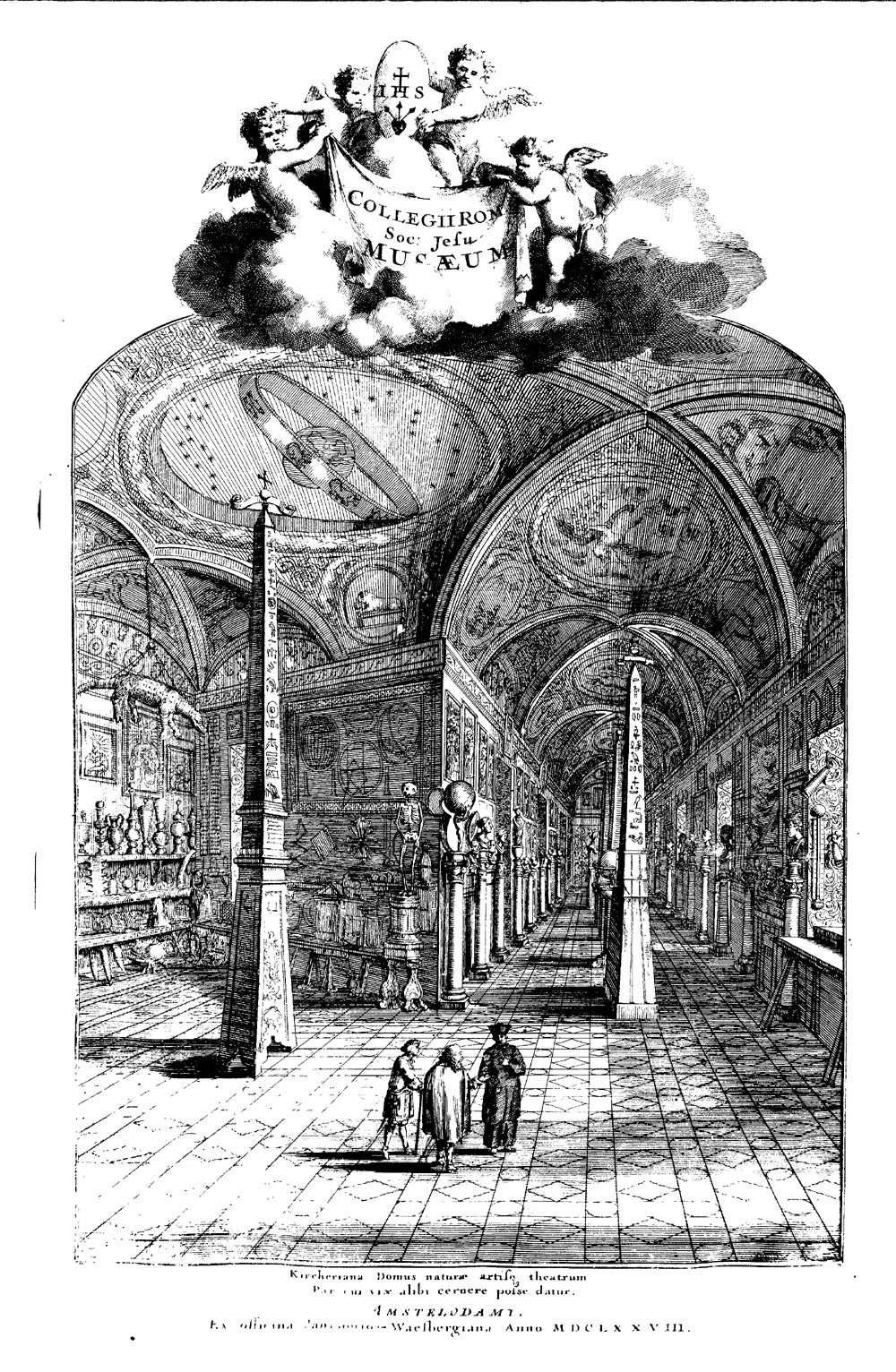
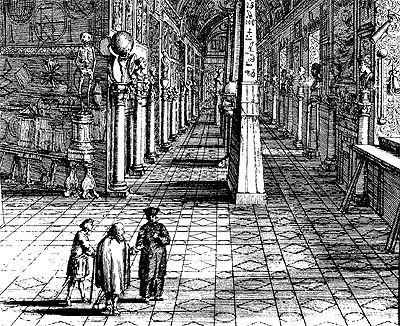
Kircher maintained a museum in Rome's Collegio Romano. The illustration above is from Giorgio de Sepibus's 1678 catalog of the museum. (click to see the full image). The museum contains the range of his interests: curiosities of nature, sculptures, Egyptian obelisks, and many of his mechanical marvels, all capped by a cosmic ceiling. Not shown in the images, but listed in the catalog, are a lizard encased in amber and a pair of creatures that were most likely the same species as the Zymoglyphic Museum's Jenny Haniver. The museum also included bound volumes of his correspondence, the 17th century equivalent of a curator's web log. His museum was really an extension of himself and went into decline soon after his death. The mechanical marvels stopped working and the more fanciful specimens disappeared. A catalog of the museum published in 1760, 80 years after his death, listed only antiquities.

I had not heard of him when I was younger, but I was afflicted with the same desire to know everything. I had a similarly wide range of interests: linguistics, cosmology, anthropology, biology. I ended up not going into science beacuse I could not specialize, and because science, broad as it was, still seemed too limited to physical reality, too literal, lacking in imagination. Perhaps creating a multi-faceted, personal museum has been the inevitable outcome.

The spirit of Father Kircher walks among us today in the form of the Secretary of the Athanasius Kircher Society. The society's Proceedings are daily writeups of the sorts of curiosities and esoterica that would have interested Kircher, and consistently the most interesting of the "oddities" blogs. The Proceedings have in the past year featured two of the Zymoglyphic Museum's collections, the Xenophora, shells that collect shells, and the miniature viewing stones. The Kircher Society recently has its first annual meeting in New York.

The Museum of Jurassic Technology in Los Angeles has an excellent exhibit on Kircher that reproduces many of his mechanical wonders.

The museum image above is from Stanford University's highly recommended Athanasius Kircher Project. Information about Kircher's museum is drawn from Paula Findlen's article "Science, History, and Erudition: Athanasius Kircher's Museum at the Collegio Romano" in The Great Art of Knowing: The Baroque Encyclopedia of Athanasius Kircher