Saturday, August 21, 2010

Visions of Alice


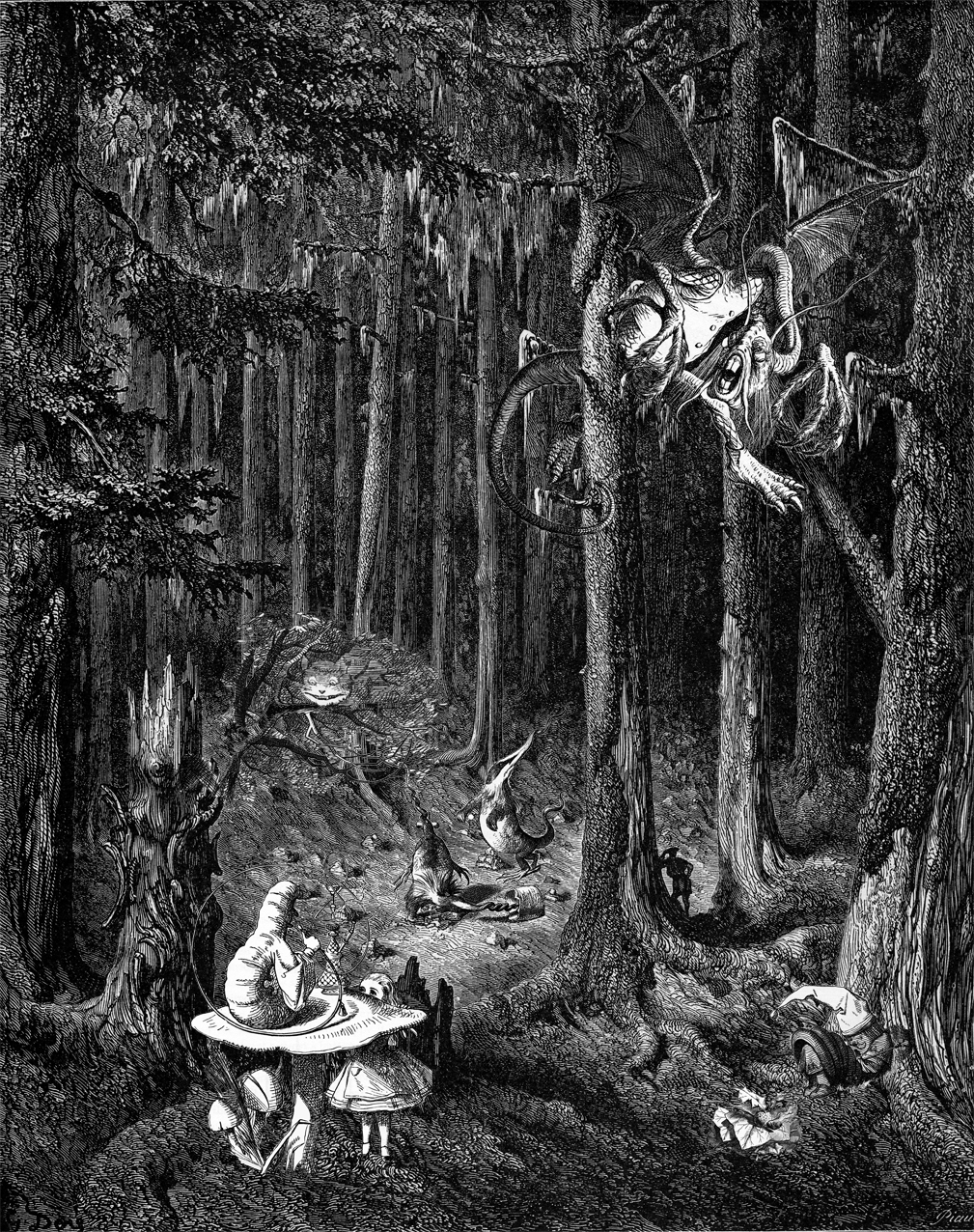
Deep in the tulgey forest, Alice receives some confounding advice from the Caterpillar whilst a pair of slithy toves gyre and gimble. Nearby, resting in a sunny spot, is a Snap-dragon-fly, "its body made of plum-pudding, its wings of holly-leaves, and its head a raisin burning in brandy". The Red Knight is snoozing against a tree. The Jabberwock is trying to get some attention, but no one wants to awaken the Red Knight, since they are all phantoms of his dream.

Herewith we present a commemorative collage from the museum's publications department, featuring an arrangement of some of John Tenniel's original illustrations, set in a "tulgey wood" provided by Gustave Dore. Most of the collages in this series are views of the Zymoglyphic region, which, in fact, is not very far from Wonderland. See a previous blog entry for more of Alice's influence on the region.

A blockbuster version of the Alice story recently hit the big screen, transforming two complex, multi-level tales into a conventional battle of good vs. evil, albeit with eye-popping visuals. The museum's marketing department had advised us to cling tight to its coat-tails to promote this print, but the blog department was, like the White Rabbit, late. The print is nevertheless available in various sizes and framing options here

This collage was recently featured at Alicenations, one of the blogs maintained by Adriana Peliano of the Sociedade Lewis Carroll do Brasil. Adriana also creates amazing assemblages and collages inspired by the Alice stories, as well as traditional tales.

Two other Lewis Carroll societies exist, in the U.S. and the U.K, both tending toward somewhat more academic pursuits. This is perhaps the most interesting part of Carroll's legacy - that a synthesis of mathematical logic, wordplay, dream logic, storytelling invention, and a timeless view of childhood can inspire an apparently inexhaustible variety of movies, art, plays, and scholarly analysis.

Tuesday, May 25, 2010

A Tumultuous Week at the Museum


The Zymoglyphic Museum's news desk is a sluggish thing, and is only just now getting around to reporting the events of the week beginning May 8th. The week opened with a very successful Open Day on that Saturday. Visitors converged from far and wide, including a pair who bicycled down from San Francisco, and others who came from Alameda, Berkeley, Mount Madonna, and possibly even further. Sunday morning came down with unseasonable rain coupled with a burst pipe in the exhibit preparation area, but the rest of the day went well, and included an impromptu Mother's Day tea in the museum's forecourt. One visitor sported a fine octopus tattoo based on an Ernst Haeckel design. Haeckel was an artist/scientist whose work features prominently in the Views of the Zymoglyphic Region.

During all this commotion, an uncommonly bold Bewick's wren was constructing a nest in the base of Scholar Monk's tree in the museum forecourt. He (the male builds the nest, subject to approval by the female) busily gathered sticks many times his own size, bits of moss, wool (provided by museum staff), and dry leaves, and assembled his homestead. Our stealthy museum photographic staff captured some of the activity.

Finally, late the next Friday night, while we dozed unawares, an alleged miscreant was apparently trapped by police in the cul-de-sac and an ensuing fracas toppled much of the museum's forecourt, leaving splotches of blood on the driveway among the deconstructed art. Authorities have been tight-lipped about what actually transpired, and the structures are now mostly resurrected. The pot that contained the wren's nest was crushed, but fortunately it was unoccupied. Presumably the female wren had vetoed the location some days before and is now chirping the wren equivalent of "See? I TOLD you!!". We hope they are happily ensconced in a less chaotic location.

Sunday, April 25, 2010

Annual Open Days at the Museum


Continuing the time-honored, late-spring tradition, the museum will again open its doors to the public as part of Silicon Valley Open Studios. Potential patrons who were unable to secure tickets for Obscura Day have been granted a second chance, and other curiosity seekers will be welcomed. Visitors old and new will want to recommend the museum to their contacts, friends, acquaintances, followers, fans, correspondents, and any other such relationships that they may currently have.

Previous visitors should note that there will be the following NEW features this year:

- A newly remodeled forecourt, featuring the Garden of the Four Monks
- A display of prints from the Views of the Zymoglyphic Region series. Copies of the book will be available for sale on site.
- Sketches of the region, fresh from the curator's notebook, fleeting impressions captured in slapdash but intriguing pencil drawings.

Copies of the museum's Guide Book will be available for sale at a slight discount, and the curator will of course be available to help solve any museum-related mysteries (although there are no guarantees of satisfactory answers). Photography is encouraged and selected results will be highlighted by inclusion in one of the museum's Flickr galleries.

Directions may be found here. Those who are internal-combustion-challenged should note that the museum is a 10-15 minute walk from the Hillsdale train station.

Tuesday, March 23, 2010

Obscura Day at the Museum


March 20, 2010 was Obscura Day, a set of 80 events around the world celebrating "wondrous, curious, and esoteric places". The day was sponsored by Atlas Obscura, an online compendium of such locations. The front men for the atlas are Joshua Foer (of the late lamented Athanasius Kircher Society) and Dylan Thuras (of the current and celebrated Curious Expeditions blog). A few of the museum's collections were presented in the Kircher Society's proceedings some years ago and the museum itself is currently listed in the Atlas Obscura.

The event was not publicized because it filled up early in February, much to the amazement of the museum's marketing department, which has struggled in vain for years to get people out to the wilds of San Mateo. Any potential patrons who missed out are reminded that the museum will be open again May 8th and 9th as part of Silicon Valley Open Studios.

There had been some concern on the part of museum management that visitors would be dropping by simply to gawk at something "eccentric" or perhaps just to be part of a trendy event . These fears proved unfounded as visitors showed genuine interest, as evidenced by the quality of the photographs taken. Samplings of these pictures have been gathered into galleries on the museum's Flickr page:

Zymoglyphic Museum Closeups
Photographers became absorbed in the details of the exhibits. Small components of the exhibits come alive in an amazing variety of ways in these pictures.

Zymoglyphic Dioramas
Kathryn Gritt came early, had the museum to herself for a good long while, and documented everything. She was especially successful at capturing the dioramas, which are a challenge to photograph well. Best of all, she produced two excellent little videos which capture the three dimensional qualities of the dioramas.

Hardly any visitors took pictures of themselves or others in the museum, so museum management has contributed a few documentary shots of the day that can be seen here

Sunday, February 14, 2010

27 Views of the Zymoglyphic Region


A previous post somewhat prematurely announced the discovery of a number of historical views of the Zymoglyphic region. Many more of these views have since surfaced and are now available in book form from the museum shop. You can also order individual poster size prints, framed or unframed. A generous sampling of the views may be seen here.

These views show the natural history of the area and scenes of daily life in its villages, woods, and jungles, beginning with the wet, humid, lowlands where Rust Age customs still hold sway, moving through the mountainous uplands, and finally entering the buzzing capital city at its center, as well as some of the more remote wonders on the region. Its people are engaged in creative, if often enigmatic, activities, in a landscape of strange and strangely familiar creatures, chimeras, and spirits.

Our resident Scholar Monk has discovered that these supposed documents are but fevered dreams, cobbled together from various European engravings whose sources have been tracked down. Most of them date from northern Europe's Age of Wonder, a world of extravagant architectural excess, grotesquerie, fabulous creatures, wunderkammers, and arcane alchemical investigations. The backgrounds owe much to a 19th century fascination with picturesque landscapes, especially Giovanni Piranesi's Roman ruins and the works of Gustave Dore. Dore's illustrations for Chateaubriand's Atala were used extensively. They imagine a primeval America of eerie dark woods, gnarled old trees, vast rivers, and tropical oases.

Much of the flora, some of the fauna, and even a bit of the architecture in these views was provided by the work of Ernst Haeckel, an artist/scientist noted for detailed depictions of plants and animals as art forms in his book Kunstformen Der Natur (1904).

In addition to numerous volumes in the Dover Pictorial Archive, two online sources have been ransacked for images. PK, a semi-anonymous blogger, has been scouring the world's digitized historical illustrations from his Antipodean outpost for many years, and posting the results at Bibliodyssey. His taste for the eccentric and propensity for high-reolution have been invaluable for this project. Mr. H explored a similar vein in the late Giornale Nuovo blog (2002-2007).

This sort of thing is not unprecedented. Other artists have used collages of old engravings, most notably the surrealist collage novels of Max Ernst, and more recently San Francisco's own Satty. The Ubu Gallery in New York recently had a show of artists who have used 19th century engravings in collage.

Monday, August 31, 2009

The Garden of the Four Monks


The Museum's forecourt has gotten a major upgrade this summer, inspired by a generous grant of rusty materials, woody scraps, and other curiosa from Neva Beach. One may be forgiven for picturing Neva Beach as a pleasant shoreside locale where one can find treasures from the sea, and this is, in a sense, true, but Neva, properly speaking, is a person, not a place.


The xeriscape gardening against the museum's front wall is based on some gnarled stumps and includes of a number of strange plants endemic to the Zymoglyphic Isles, including land sponges (zoophytes, in fact, not plants at all) and the legendary Giant Rust Flower. This last flowers only once in its lifetime, but spectacularly, a huge colorful bloom; the flower then rusts in place, decaying slowly thereafter. Other plants derive their drought tolerance from metallic and plastic components.


The theme for the landscaping is the legend of the four Zymoglyphic monks, a tale from the Era of Oriental Influence. An ancient tradition holds that enlightenment can be sought in the study of nature and natural forces, especially rust. According to the tale, each monk set out to seek enlightenment, but as is so often the case, different schools of thought prevailed.


The Scholar Monk maintains a well-stocked library, surrounding himself with the writings of the great minds and kindred souls of the ages. He studies and reflects on them, compiles, analyzes, and synthesizes his research. He collects art and significant objects for inspiration (a favorite viewing stone, a copper nodule, is currently on display). He has staked out a breezy top-floor aerie in one of the garden plants, and installed a mobile that makes the wind visible. A little monkey comes to visit sometimes to remind him to get his nose out of his books and reconnect with nature.


The Rust Monk is less interested than the Scholar Monk in what other people have said and done. He wants to find his own unique way, unencumbered by the past, listening to an inner voice. He seeks enlightenment from his creative expression, to express things that cannot be said in words. He has collected a number of rusty objects and assembled them to create a complex living environment. His creation floats above the garden, not rooted in any part of it.


The Wandering Monk has decided to rid himself of the distractions of possessions, collections, books, and art, no matter how pure or ennobling they may be. He has kept only a bag full of necessities and set off to wander in the wilderness, savoring the freedom of the adventure, to see what nature and rust can teach him. In the twists and turns of the thick branches of an ancient stumpy tree, he has found a rusty viewpoint from which to view the passing scene and get some perspective on the world. He will soon be moving on in his restless quest.


The Shelter Monk is a sort of hermit. Like the Wandering Monk, he has cast away his possessions, but he is content with a simple place to sit in quiet, inward contemplation, sheltered from the buffeting environment. He believes that each part of the universe contains the whole and one need only stay in one place and fully experience it to attain the sought-after enlightenment. It is not necessary to go from one place to another. He has found his spot on a flap of rust, under a wide natural shelter, and he plans to stay there.

Friday, July 31, 2009

Views of the Zymoglyphic Region


The Zymoglyphic Museum has longed claimed to be the world's repository of artifacts from the Zymoglyphic region. This is all well and good, but many have wondered just what this supposed place looks like, as the museum cuurently contains physical artifacts but no visual representations of the place itself. Our diligent curatorial staff has just unearthed some views made by artists accompanying the European and American explorers who long ago managed to penetrate the thick mists that surround the region. While some of what these images depict is be based in reality, there is much that can be attributed to the cultural biases of the image makers, not to mention tropical fevers and the gas produced by the notorious hallucinogenic fungus that populates the swampier areas of the region.

The full set can be seen here

Sunday, April 26, 2009

Behind the Scenes Tours, May 16th and 17th


Another lap around the Sun, the buds of spring are opening, and so are the creaky doors of the Zymoglyphic Museum, shaking off the rust of winter hibernation, letting in a bit of fresh air to shift the dust around and dilute the musty aromas, ready to welcome visitors. You can tour the museum, meet the curator, and go behind the scenes to see where exhibits are created (some allege that the artifacts themselves are concocted there as well). A foretaste of the exhibit preparation area is show below, sorry evidence of the inhuman conditions under which museum personnel are expected to labor.

New this year will be a small exhibit of viewing stone photographs. The museum shop will have a limited number of the new Museum Guides available for purchase. You will also be able to visit on site the studio of Judith Hoffman and delight in her artist books, metal sculpture, and metaphysical devices.

The tours are part of Silicon Valley Open Studios and will be held between 11 AM and 5 PM both days, free of charge. Details can be found here.

Saturday, March 21, 2009

The Bigfoot Discovery Museum


Mike Rugg had an encounter with a Sasquatch in northwestern California when he was four years old and has spent the rest of his long life gathering and presenting evidence to a skeptical world of the existence of these creatures. In 2004, he set up a little museum by the side of the road in Felton, a small town nestled in a redwood-lined valley north of Santa Cruz. Due to the elusive nature of the subjects there are very few artifacts of the creature itself, just some footprint casts, a couple of teeth of unknown origin, and some blurry video. Much of the collection consists of popular culture references to Bigfoot, including a collection of relevant Weekly World News issues ("I had Bigfoot's BABY!"). There is also a map of the Santa Cruz Mountains pinpointing recent sightings, a set of comparative skulls of other hominid species, and a diorama featuring two full size Bigfoot models. The diorama was dark and its contents appropriately difficult to photograph.


My own childhood did not involve any sightings, but I was fascinated by UFOs, the Loch Ness Monster and related phenomena. I grew up reading the books of Charles Fort and Ivan Sanderson. Fort was a chronicler of paranormal wonders such as rains of frogs, giant wheels of light observed at sea, poltergeist activity, and spontaneous combustions, events that once might have been called "miracles." Sanderson was a pioneer of the field of cryptozoology, which uses the modern language of biology to establish the literal existence of animals that might otherwise be considered mythical. Its basic premise is that it is at least possible that large unknown animals exist in our modern world whose existence is unreasonably denied by the scientific establishment. Usually, they can only be detected by indirect evidence, eyewitness accounts, and the occasional blurry photograph or film.

In its flesh-and-blood form, Bigfoot is presented as a surviving remnant of an anthropoid race ancestral to humans. It is believed to be omnivorous, sometimes taking fruit from local trees and snatching chickens from pens, but otherwise harmless. Some Bigfoot researchers postulate that the creature has magic properties and can turn invisible.

If nothing else, the Bigfoot Museum supports the idea that there is still some mystery in the world, that not everything has been explored, that there is hope for a discovery that shakes our everyday assumptions. It harkens back to the Age of Wonder when nautical maps sported mermaids and other fanciful sea creatures, a world view on the edge of science and magic. There is something significant on the periphery of our vision, and try as we might to get it into focus, it always manages to elude us.

See also Loren Coleman's International Cryptozoology Museum in Portland, Maine and the Bigfoot exhibit at the Willow Creek-China Flat Museum in northern California.

Friday, March 13, 2009

Spirits under glass


This past weekend saw a return to the de Young museum's ethnographic collections, first profiled here three years ago. This time I was armed with a new image-stabilized camera to meet the challenge of the museum's "no tripod, no flash" photography rules, with the results found here.
The collections are drawn from Africa, pre-Columbian Mexico, and especially New Guinea.
Most of these objects originally had specific roles in the spiritual life of the community. They have fascinated Westerners for centuries as strange objects from exotic realms. To some, they were grotesque pagan idols, representing ignorance and savagery, and to the Romantics a glimpse into a purer human, one more deeply connected to the basics of existence from which we as industrialized people have become alienated. Anthropologists collected, identified, classfied, and recorded these objects, as a biologist would do with natural specimens, and they are often still displayed in natural history museums. In the early modern era, artists, especially those connected with the surrealist movement, saw these object as having genuinely inspirational aesthetic qualities which could be appreciated independent of their spiritual function. Finally, oceanic imagery devolved into kitsch with the development of the Tiki culture.
One function of a museum is to try stop the passage of time, to preserve decaying things under bell jars or pickled in brine, bringing dead things back to life in dioramas, preserving the artifacts of the past. Encased in the sleekly modern architecture of the museum we see organic figurines, made of wood, clay, stone, or feathers, once living spiritual objects, extracted from dying cultures, forever frozen in action in their vitrines.

For another photographic perspective on this collection, see here.

The de Young's New Guinea collection is documented here

The Pitt Rivers Museum in Oxford contains a wealth of ethnographic artifacts in a Victorian setting. Its Web site offers a virtual tour

The Metropolitan Museum in New York City has a wonderful collection of African, Oceanic, and pre-Columbian artifacts, nicely documented here.

An excellent reference on the influence of "primitive" art on 20th century artists can be found here.