Showing posts with label Museum objects. Show all posts

Sunday, November 11, 2007

Chinese Root Carving


The Zymoglyphic Museum's Department of Special Collections has recently acquired for its curiosity cabinet this fine example of a root carving, a folk art tradition that goes back at least 2,000 years in China. Root carving is one of a number of Chinese and Japanese arts based on creating art from nature, with the focus on the natural characteristics of the object. We have previously covered ikebana, the Japanese art of arranging natural objects, and viewing stones, or scholar's rocks, which are complex stones presented for contemplation.
In this root carving, the anonymous artist has created an image not of a specific animal, but a dynamic creature of the imagination, full of life force, complete with hints of bones, sinews, musculature, and body cavities, all done through simple but effective highlighting of the natural features of the selected object.
A related folk art form is the carving of bamboo root, whose whiskery texture lends itself well to making intriguing masks. The museum has recently acquired an example of one of these masks, made by a member of the Tamang tribe of Nepal.

Saturday, August 11, 2007

The Rainbow Jewel from Another Planet


The object shown above is the Zymoglyphic Museum's acquisition number 1. According to legend, this mysterious object came to the Zymoglyphic region from another planet, carrying within it the seed of the museum.


My boyhood museum, was, like most modern museums, primarily dedicated to a fairly literal, scientific view of the world. I wanted to identify things accurately and categorize them correctly. However, this particular object is one of a couple of items in that original museum that were relics of an earlier, more fanciful, era. inspired by Superman's museum in his Fortress of Solitude. His museum included an alien zoo, souvenirs of his exploits and his trips to exotic places, and, most interesting to me, an entire city in a bottle, which may have been the inspiration for the creation of the Zymoglyphic dioramas many years later. Normally a very private space, Superman's museum was, like the Zymoglyphic Museum, open to visitors on occasion. In this story from Action Comics #261 (July, 1958), he brings the entire fortress to Metropolis so people can tour it.


One item that I had in my original museum was a bar of some kind of metal that was much softer than it looked. I bent it into an "S" shape and pretended that it was something that Superman himself might have created and displayed as a museum exhibit. The other was this small, multicolored chunk of melted material that I imagined was some sort of mysterious extraterrestrial artifact, possibly related to the "rainbow jewel from another planet" in Superman's museum. The "S" bar is long lost, but the rainbow jewel has survived through the years and is now on view in the Zymoglyphic Museum atop its own little pedestal, framed in the style of a viewing stone, .

Sunday, April 29, 2007

New Diorama: Dream House


The Zymoglyphic Museum has just added a new diorama in an unusual style. Zymoglyphic dioramas are most frequently constructed in fish tanks or vitrines; this one uses an old display case to show a modern couple connecting to their "roots" in a most literal sense. For another view of domesticity in a diorama, see The Quiet Parlor of the Fishes

Sunday, March 18, 2007

Ikebana: An Ancient and Modern Natural Art from Japan


I went up to San Francisco last weekend to see the biennial Ikebana Flower Show in Golden Gate Park. Ikebana originated some five hundred years ago in medieval Japan as a spiritual expression of natural energies, often in association with Zen Buddhism. It is primarily a formal arrangement of flowers, branches, and a variety of other objects, usually placed on a stand or in a vase. Ikebana can celebrate any season, but it is at its best as celebration of the rebirth of nature in spring.

Both ancient and modern approaches were represented in the show. The arrangement at the top left, by Grace Murata, is in the Ikenobo style, a traditional school which dates back to the 15th century and emphasizes formal training. On the upper right is a more modern version from Keiko Yamamoto using hair clips and wadded up newspaper, in the Sogetsu style. Sogetsu is a school founded in 1927 which encompasses a broad range of styles, including free form and avante-garde, and invites participation by anyone. The lower arrangement, by Michiko Hosada, is an example of the Chiko school, which can include architectural elements, figures, and other objects to create symbolic landscapes. Examples from some of the many other schools of ikebana can be seen here and here.

Ikebana is much like Zymoglyphic art, especially that of the Era of Oriental Influence. Both are based on the assemblage of (mostly) natural objects, selected, arranged, and composed for a poetic effect, and placed in some framing context, such as a stand or a decorative vase. Both aspire to be something more than simple decoration. An ikebana arragment, such as the one shown below, may contain materials familiar to fans of Zymoglyphic art, such as dried fungus, mossy branches, gnarled driftwood, wire, seaweed, or rusty objects (although we are unaware of any ikebana containing dead animals). The focus on fresh flowers usually makes ikebana a more evanescent art than a typical Zymoglyphic artist would prefer, needing to be constantly renewed and redone, surviving only in pictures and memories. The museum's curiosity cabinet contains an example of a more durable ikebana arrangement, acquired at the 1998 ikebana show.


A good introduction to ikebana, focusing on the wide-ranging Sogetsu school, is Ikebana: A Practical and Philosophical Guide to Japanese Flower Arranging The image here is taken from that book.

Sunday, October 01, 2006

Notes from the Museum's Mermaid Tank


Mermaid collecting has had a rather difficult and controversial history. Mermaid collectors are often beguiled by artists' depictions of full-size, curvaceous, fish-women, but the actual specimens that show up in collections tend to be much shorter and not really all that human-looking. Some species seem to be a primate-fish mixture, with the type specimen generally regarded to be P.T. Barnum's Feejee Mermaid, exhibited at his American Museum. Modern versions can be seen here.

The Zymoglyphic Museum's new curiosity cabinet acquisition, shown above, belongs to a family of mermaids that has been referred to throughout history by the common name "Jenny Haniver".

This related species appears in Ulisse Aldrovandi's posthumously published 1642 work, Monstrorum historia


This sighting of a somewhat more primitive species is from Ambroise Pare's 1573 work, On Monsters and Marvels

This one appears in Mary Thompson's 1960 natural art classic, The Driftwood Book (photo by Leonid Skvirsky)


This specimen is from the 1975 catalog of the Wonders of the World Museum.

The Zymoglyphic museum's new acquisition joins two existing specimens in its natural history department. This one, referred to as the Zymoglyphic Mermaid, is endemic to the Zymoglyphic region. Also native to the region is a primitive flying species known as the Leatherwing.

Tuesday, August 29, 2006

The Quiet Parlor of the Fishes


Late in the 1980's, before the Zymoglyphic Museum existed, I had an idea to make an aquarium, not with water, but a scene with a sandy bottom. This would be a big version of the surreal scenes in sandtrays that I had been making at that time. I was recently married then, and the theme was of two fish making a home in a strange world. I liked the idea that the result would be a piece of furniture you would have in your house, rather than a piece of art intended for a pedestal in a gallery. It was even rather practical, in that it would be very low maintenance for an aquarium. The aquarium was made of various things that I had found and had been given. My wife was making intricate hinged fish out of metal and plexiglass, and I thought an aquarium would make a nice home for some of them.

Even the title, "The Quiet Parlor of the Fishes", is a found object, taken from Thoreau's "Walden":

I cut my way through a foot of snow, and then a foot of ice, and open a window under my feet, where, kneeling to drink, I look down into the quiet parlor of the fishes, pervaded by a softened light as through a window of ground glass, with its bright sanded floor the same as in summer; there a perennial waveless serenity reigns as in the amber twilight sky, corresponding to the cool and even temperament of the inhabitants. Heaven is under our feet as well as over our heads.

"Walden" was one of my favorite books in high school. It provided a mythic and spiritual dimension to nature that transcended the mere collecting, naming, and classifying of specimens, which had been the focus of my original museum. The summer between high school and college, I even tried a brief emulation of Thoreau's year-long stay at Walden pond. I camped out by myself for four days on an island in the middle of a small mountain lake in Olympic National Park. I paddled out to the island on a primitive boat made by tying driftwood logs together, read Walden, and wrote a short journal, trying to emulate Thoreau's 19th century style.


In this dry aquarium, the two fish have a little television set in their parlor and are watching a program that features one of the Judy's art-fish. They also have their own little dry aquarium, foreshadowing the worlds-within-worlds theme of the museum-to-come. This first aquarium was followed by a series of small dioramas inside standard 10-gallon aquariums. Some had a terrestrial theme and some were aquatic. The serenity of the underwater world, eternal and unchanging, gave way to the archetype of the primordial ooze, a crowded, dense, active, messy world of creation, decay, and conflict, and a Walden-like mythological cycle of death and rebirth.


In recent years, I have been trying to capture a sense of the little worlds inside the dioramas in close-up photography and I think this is one of the more successful attempts. It is the little aquarium in fishes' parlor. This picture was, in fact, my entree into hallowed halls of the Museum of Dust.


In the past couple of months, Judy has been experimenting with pinhole photography, using homemade mini-cameras. I was not convinced of the true potential of this technique until she took some photos of the aquarium, which gave the whole thing a dreamlike air. The full set of photos can be seen here. One of the those photos, of an astronaut from the moon who is coming to visit the fish, resulted in her own initiation into the Museum of Dust.

Saturday, July 29, 2006

Surrealist Barbie

In primitive societies, there are often particular figurines considered to have great power within the culture. For us, the Barbie doll seems to serve that function. Such is the power of this figurine that she has managed to stay trendy for more than 50 years in the ever-changing worlds of fashion and toys. She has even penetrated the august halls of the Zymoglyphic Museum, where current events are rarely acknowledged and brand names hardly ever seen.

My niece went through a fairly heavy Barbie phase in her pre-teen years. One Christmas when we were visiting, she presented me with this rearranged doll which is now enshrined as the ultra-rare Surrealist Barbie of the museum's curiosity cabinet. It is still exactly as she gave it to me. Later, she sent me some heads and a few body parts for me to use in art projects (see note below). Then, no doubt inspired by her visit to the museum, she created Nude Barbie-zilla.


It turns out that deconstructing Barbies is practically a cottage industry. The prevalence of girls mutilating their Barbies in various ways was the subject of a recent study at the University of Bath. The Market Street Gallery in San Francisco hosting the fourth annual Altered Barbies show with more than 50 artists participating. It runs through August 27th.

Sunday, February 26, 2006

The Zymoglyphic Meteorite


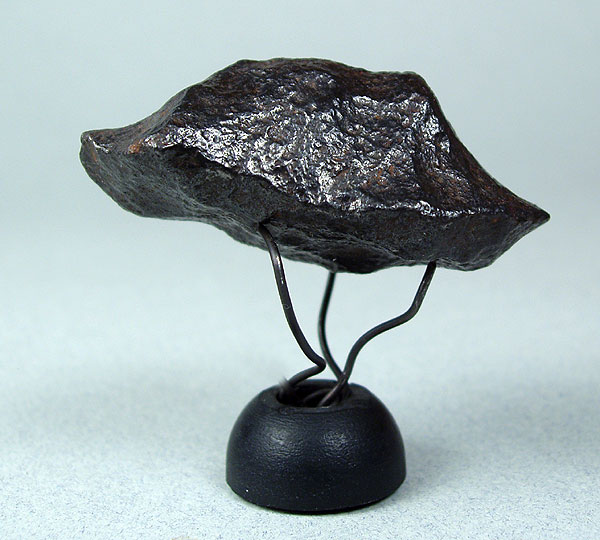
When I was a boy, I would troll the beach with a magnet tied to a long string, hoping to snag a torn-off bit of the cosmos in the form of an iron meteorite. As an adult, I found out that if you want one, you can just buy one. This one is from the Gibeon fall, a meteor that broke apart over Namibia in prehistoric times. It was originally part of the iron core of an asteroid that later broke up. Its melted, pitted exterior marks its fiery passage through the Earth's atmosphere, but its inner crystalline structure has not changed in 4 billion years. To me, it is the equivalent of a medieval relic, a connection to the universe and its creation.

One of the holiest relics of Islam (and its predecessors in Arabia as well) is a meteorite embedded in its central shrine at Mecca. One legend has it that this stone, too, dates from close to creation, falling at Adam's feet and subsequently discovered by Abraham.

The Hall of Meteorites in New York's American Museum of Natural History has an excellent exhibit (virtual and physical) on meteorites.