Showing posts with label Personal anecdotes. Show all posts

Saturday, July 02, 2011

Skip's Museum

The second most frequently asked question from visitors to the museum (after "What does 'zymoglyphic' mean?") is "How long have you been doing this?" The long answer involves a tale of a childhood museum, collections of bird nests, shells, rocks, stamps; decay; changing interests; back to collecting again and eventually the resurrection of the museum. That story can be found in more detail here.

Near the outset of Kurt Vonnegut's 1959 novel The Sirens of Titan, Malachi Constant, the richest and luckiest man in America, visits Winston Niles Roomford, a similarly wealthy space traveler who is caught in a "chrono-synclastic infundibulum," spread out across space and time but on occasion materializing in his palatial home. The visit occurs during one of these materializations and includes the following vignette as part of the tour Roomford gives Constant:
[ Roomford] led the way down a back corridor and into a tiny room hardly larger than a big broom closet: It was ten feet long, six feet wide, and had a ceiling, like the rest of the rooms in the mansion, twenty feet high. The room was like a chimney. There were two wing chairs in it.
"An architectural accident —" said Rumfoord, closing the door and looking up at the ceiling.
"Pardon me?" said Constant.
"This room," said Rumfoord. With a limp right hand, he made the magical sign for spiral staircase. "It was one of the few things in life I ever really wanted with all my heart when I was a boy — this little room."
He nodded at shelves that ran six feet up the window wall. The shelves were beautifully made. Over the shelves was a driftwood plank that had written on it in blue paint: SKIP'S MUSEUM.
Skip's Museum was a museum of mortal remains — of endoskeletons and exoskeletons — of shells, coral, bone, cartilage, and chitin — of dottles and orts and residua of souls long gone. Most of the specimens were those that a child — presumably Skip — could find easily on the beaches and in the woods of Newport. Some were obviously expensive presents to a child extraordinarily interested in the science of biology.
Chief among these presents was the complete skeleton of an adult human male.
There was also the empty suit of armor of an armadillo, a stuffed dodo, and the long spiral tusk of a narwhal, playfully labeled by Skip, Unicorn Horn.
"Who is Skip?" said Constant.
"I am Skip," said Rumfoord. "Was."

"...dottles and orts and residua of souls long gone" has become a favored phrase in the museum's PR department. A dottle is the "wet and sour-smelling mass of unburned tobacco found at the bottom of a tobacco pipe." The Zymoglyphic Museum does not actually possess any known dottles in its holdings, but some of its more indefinable artifacts could plausibly be confused with them.

Saturday, August 11, 2007

The Rainbow Jewel from Another Planet


The object shown above is the Zymoglyphic Museum's acquisition number 1. According to legend, this mysterious object came to the Zymoglyphic region from another planet, carrying within it the seed of the museum.


My boyhood museum, was, like most modern museums, primarily dedicated to a fairly literal, scientific view of the world. I wanted to identify things accurately and categorize them correctly. However, this particular object is one of a couple of items in that original museum that were relics of an earlier, more fanciful, era. inspired by Superman's museum in his Fortress of Solitude. His museum included an alien zoo, souvenirs of his exploits and his trips to exotic places, and, most interesting to me, an entire city in a bottle, which may have been the inspiration for the creation of the Zymoglyphic dioramas many years later. Normally a very private space, Superman's museum was, like the Zymoglyphic Museum, open to visitors on occasion. In this story from Action Comics #261 (July, 1958), he brings the entire fortress to Metropolis so people can tour it.


One item that I had in my original museum was a bar of some kind of metal that was much softer than it looked. I bent it into an "S" shape and pretended that it was something that Superman himself might have created and displayed as a museum exhibit. The other was this small, multicolored chunk of melted material that I imagined was some sort of mysterious extraterrestrial artifact, possibly related to the "rainbow jewel from another planet" in Superman's museum. The "S" bar is long lost, but the rainbow jewel has survived through the years and is now on view in the Zymoglyphic Museum atop its own little pedestal, framed in the style of a viewing stone, .

Sunday, January 21, 2007

New Philatelic Wing Opens


The Zymoglyphic Museum is now in the process of putting its philatelic collection online. The first installment can be seen here.

"What attraction, dear reader, has a postage stamp for you?...Is it a symbol of ordinariness, or is it the ultimate within the bounds of possibility, the guarantee of unpasssable frontiers within which the world is enclosed once and for all?...A stamp album is a universal book, a compendium of knowledge about everything human. Naturally, only by allusion, implication, and hint. You need some perspicacity, some courage of the heart, some imagination in order to find the fiery thread that runs though the pages of the book."

From the story "Spring", in The Sanatorium under the Sign of the Hourglass by Bruno Schulz

My original museum, from when I was about 10 or 11, primarily included natural history objects, such as shells, rocks, and the occasional animal skin. However, like any decent curiosity cabinet, it also included cultural artifacts: arrowheads, kachina dolls, some square nails, and a worldwide stamp album. The stamps gave me a sense of connection to faraway, exotic places and collecting them created a sort of microcosm of the world. I was especially fascinated by the tiny, independent republics and principalities of Europe and idyllic scenes from isolated topical islands. The stamps of Africa and Oceania introduced me to romantic images of tribal art and lifestyles. My goal was to collect a stamp from every country in the world. I eventually lost interest in collecting stamps when exotic-sounding places like Bhutan, Tonga, and various Arabian sheikdoms started issuing gimmicky stamps which were clearly aimed at collectors and had no connection to their own cultures.

Later, in my forties, we inherited my wife's grandfather's collection of worldwide stamps. Judy had also been a collector as a girl, and it was something she and her grandfather would do together. While poring through this old album, I was inspired to start collecting again, taking up the task of collecting at least one stamp from every stamp-issuing entity. I spent a lot of pleasant weekend days hunting at local stamp shows and finding a stamp or two from some ever more obscure place. The total currently stands at more than 600 countries, territories, and other postal administrative units of the past and present.

Because of my interest in (and sympathy with) things that don't fall into standard categories, I became attracted to stamps known as "cinderellas" that were spurned by the mainstream collectors. These included stamps issued by independence movements in places such as Biafra and Chechnya, local postage from various British islands, and stamps produced by micronations. These have become the "exotic locales" of the modern world. Finally, I added the infinite and entirely imaginary geography of artist's stamps to my collecting. These can be any image in postage stamp size and style, but I have limited myself to ones purport to be from somewhere.

Tuesday, August 29, 2006

The Quiet Parlor of the Fishes


Late in the 1980's, before the Zymoglyphic Museum existed, I had an idea to make an aquarium, not with water, but a scene with a sandy bottom. This would be a big version of the surreal scenes in sandtrays that I had been making at that time. I was recently married then, and the theme was of two fish making a home in a strange world. I liked the idea that the result would be a piece of furniture you would have in your house, rather than a piece of art intended for a pedestal in a gallery. It was even rather practical, in that it would be very low maintenance for an aquarium. The aquarium was made of various things that I had found and had been given. My wife was making intricate hinged fish out of metal and plexiglass, and I thought an aquarium would make a nice home for some of them.

Even the title, "The Quiet Parlor of the Fishes", is a found object, taken from Thoreau's "Walden":

I cut my way through a foot of snow, and then a foot of ice, and open a window under my feet, where, kneeling to drink, I look down into the quiet parlor of the fishes, pervaded by a softened light as through a window of ground glass, with its bright sanded floor the same as in summer; there a perennial waveless serenity reigns as in the amber twilight sky, corresponding to the cool and even temperament of the inhabitants. Heaven is under our feet as well as over our heads.

"Walden" was one of my favorite books in high school. It provided a mythic and spiritual dimension to nature that transcended the mere collecting, naming, and classifying of specimens, which had been the focus of my original museum. The summer between high school and college, I even tried a brief emulation of Thoreau's year-long stay at Walden pond. I camped out by myself for four days on an island in the middle of a small mountain lake in Olympic National Park. I paddled out to the island on a primitive boat made by tying driftwood logs together, read Walden, and wrote a short journal, trying to emulate Thoreau's 19th century style.


In this dry aquarium, the two fish have a little television set in their parlor and are watching a program that features one of the Judy's art-fish. They also have their own little dry aquarium, foreshadowing the worlds-within-worlds theme of the museum-to-come. This first aquarium was followed by a series of small dioramas inside standard 10-gallon aquariums. Some had a terrestrial theme and some were aquatic. The serenity of the underwater world, eternal and unchanging, gave way to the archetype of the primordial ooze, a crowded, dense, active, messy world of creation, decay, and conflict, and a Walden-like mythological cycle of death and rebirth.


In recent years, I have been trying to capture a sense of the little worlds inside the dioramas in close-up photography and I think this is one of the more successful attempts. It is the little aquarium in fishes' parlor. This picture was, in fact, my entree into hallowed halls of the Museum of Dust.


In the past couple of months, Judy has been experimenting with pinhole photography, using homemade mini-cameras. I was not convinced of the true potential of this technique until she took some photos of the aquarium, which gave the whole thing a dreamlike air. The full set of photos can be seen here. One of the those photos, of an astronaut from the moon who is coming to visit the fish, resulted in her own initiation into the Museum of Dust.

Sunday, August 13, 2006

Kaolithic Curiosities at the Wonders of the World Museum

I don't recall exactly what drew me to Port Costa in the late 1970's. It's a tiny town in the outer reaches of the Bay Area, on the road to nowhere else, on a bank of the Sacramento River. Downtown consisted of some old buildings, a relatively large restaurant/bar popular with bikers, and a few antique store/curiosity shops. My attention, however, was immediately drawn to a storefront that housed the Wonders of the World Museum ("Stands Alone on Earth"), presided over by one Dr. George Gladstone.

Wonders indeed. There were many fascinating exhibits, many of which dated from the Pre-Credulous Era of the Bone Age, when fossils metamorphosed into ceramic instead of rock by a process known as Kaolism. Hominids in that age came in a huge variety of sizes. There was an 8-foot high Bigfoot with a triple-jointed penis bone, whose variety of functions Dr. Gladstone described in detail, and a numerous lilliputian race dubbed Homo Ceramicus. Two skulls of the latter were later acquired for the Zymoglyphic Museum's curiosity cabinet. Shown above is a rockpecker, whose skull could be used as stone-shaping tool. As a complement to the fossilization process of Kaolism, I learned how life can be created from mud, albeit with some unusual results.

The visit turned out to be good timing, because the museum was only in existence for a few years. It left a lasting impression on me, though, and when I finally had my own museum, I thought I would seek out the man behind Dr. Gladstone, Clayton Bailey. Three years ago, in July of 2003, I contacted Clayton via e-mail and he was gracious enough to give me a tour of his studio. He still lives in Port Costa, behind a fence topped by ceramic gargoyles of his own making. The big studio contains a large herd of robots, all of which are descended from a single robot originally designed to retrieve specimens for the museum from outer space. Instead, that first robot took over Clayton's brain and commanded him to create more robots. The Kaolithic Curiosities are now resting picturesquely in the yard (see above), maybe to be re-excavated and analyzed by a future generation.

Although seen by some as a "mad scientist", Dr. Gladstone's archaeological research methods have been an inspiration to the Zymoglyphic Museum curatorial staff.

Check out the Ceramic Wonders, especially the face jugs

More photos from 2003

Reference book: Clayton Bailey: Happenings in the circus of life

Saturday, August 05, 2006

A Mysterious Document Surfaces

The Zymoglyphic Museum has somewhat of a reputation as a "museum of decay" (undoubtedly a factor in its recent targeting by the Museum of Dust). A mysterious document has recently surfaced that may or may not help explain the origins of this phenomenon. This loose notebook page was found deep in the curator's personal archives. It appears to be the record of some sort of archeological dig, apparently in his closet. The manual timestamp on the document indicates that the dig was most likely in preparation for leaving home and heading off to college a continent away.

Here is a literal transcription of the document:

2 very stale pieces of bread w/casts of pupae, presumably carpet beetles, as dead same found there also. Open can, no mold on bread
Cardboard can w/mistletoe, dead and moldy
Separate substance so moldy as to be unrecognizable
Piece of wrapped cheese, brown liquidy and stinking like hell
Dried leaf of lichen, brown but not moldy
Plastic dish with spoon and white powder
Nylon plankton net
Mold on plate under glass, indicating square outline of something that had been there. No smell.
Jar with moldy prunes - now only moldy pits are left & some gunk on sides & bottom of jar. No smell. Rotting for many years
Old spider nests in jars found in closet - explains spiders in here. Jar w/bread(?) explains beetles. Now how did sow bugs get in here?

Saturday, July 29, 2006

Surrealist Barbie

In primitive societies, there are often particular figurines considered to have great power within the culture. For us, the Barbie doll seems to serve that function. Such is the power of this figurine that she has managed to stay trendy for more than 50 years in the ever-changing worlds of fashion and toys. She has even penetrated the august halls of the Zymoglyphic Museum, where current events are rarely acknowledged and brand names hardly ever seen.

My niece went through a fairly heavy Barbie phase in her pre-teen years. One Christmas when we were visiting, she presented me with this rearranged doll which is now enshrined as the ultra-rare Surrealist Barbie of the museum's curiosity cabinet. It is still exactly as she gave it to me. Later, she sent me some heads and a few body parts for me to use in art projects (see note below). Then, no doubt inspired by her visit to the museum, she created Nude Barbie-zilla.


It turns out that deconstructing Barbies is practically a cottage industry. The prevalence of girls mutilating their Barbies in various ways was the subject of a recent study at the University of Bath. The Market Street Gallery in San Francisco hosting the fourth annual Altered Barbies show with more than 50 artists participating. It runs through August 27th.

Sunday, July 23, 2006

A Fictocryptic Museum

The Museum of Jurassic Technology has recently been enmeshed in the Museum of Dust's acquisition spree (a fate which befell the Zymoglyphic Museum not so long ago), with the MoD director proclaiming the MJT to be the "grandparent of all modern fictocryptic establishments".

I had heard about this museum for many years and had seen some of its traveling exhibits. I finally was able to visit it in person when I went to Los Angeles last August. The museum is often referred to as a "curiosity cabinet", which is generally a haphazard collection of interesting stuff, but the MJT model is really more an instructive academic museum with professional-looking exhibits, each examining some esoteric phenomenon in great detail. In this museum, however, the phenomena described may or may not be fictional, and the way the line is straddled is subtle enough to keep you guessing even when you know what is going on. The book Mr. Wilson's Cabinet Of Wonder: Pronged Ants, Horned Humans, Mice on Toast, and Other Marvels of Jurassic Technology details one writer's attempt to cut through the fog of uncertainty surrounding the museum. It is, in a way, a highly rarefied version of a circus sideshow, where some of the freaks are real and some are not, but what really matters is the atmosphere created.

"Is this place real or what?"
"It's here, isn't it?"

--Conversation overheard at the MJT, October 2000, quoted in this article

To me, the fascination of the MJT is the pure physical presence of the place, its dark lighting, well-crafted vitrines, surreal dioramas, and labyrinthine exhibit rooms, including a theater and a tea room. The image above is from a Flickr photoset of the MJT by The Blen that gives you a good sense of what the museum is like. It's interesting to compare the MJT with Steven Millhauser's Barnum Museum which, being made entirely of words, is not subject to any physical laws.

While not truly an inspiration for the Zymoglyphic Museum, there has been some pollination wafting our way from the southland. The physical existence of the Zymoglyphic Museum is important, in that it exists in a geographic location and has real objects in it, but there is more of an emphasis on outreach through photography and web presence than on perfecting the physical exhibit space. The Lower Jurassic is much more technologically oriented than the Zymoglyphic culture, which tends toward rust and decay anyway. The Zymoglyphic Museum, like the MJT, has sometimes been accused of lax standards in the factual accuracy of its presentations (which it can neither confirm nor deny), and both may ultimately turn out to be physical manifestations of the internal worlds of their creators.

Saturday, June 03, 2006

Alice and Me in Wonderland


I must have seen the Disney version of Alice in Wonderland on TV when she and I were the same age. I watched it again just recently and remembered how spooky it was, especially the Cheshire cat. The poor girl, it seemed to me, was just trying to get along in the this strange world and no one will help her; they can only speak in riddles and nonsense.

In high school I discovered Martin Gardner's The Annotated Alice. I was fascinated by the fact that Lewis Carroll was a mathematician and logician, and that the Alice stories were full of logical conundrums, linguistic inventions, propositional calculus and chess strategy. I also liked the way Carroll captured dream logic. In one scene, Alice is in a shop trying to focus on an interesting item on a shelf, but it is always on the next shelf above. When she tries to trap it at the top, it disappears through the ceiling.


I was quite tickled when the Jefferson Airplane had a hit with White Rabbit, since it was based on what I was then seeing as an rather intellectual exercise. In college, the Disney film was in heavy rotation at campus film fests. Alice, her mushrooms, and the "hookah-smoking caterpillar" had now become psychedelic icons, the rabbit hole a gateway to an alternate reality. Like Carroll, I was equally fascinated by math and logic, and by the free form view of reality that nonsense provided.

This whole reminiscence of Alice started when I watched Jan Svankmajer's film, Alice. In this version a mostly-live-action Alice (sometimes transformed into a doll) chases a taxidermied rabbit that has broken out of its case and is leaking sawdust as he runs. She is beset along the way by an amazing variety of monsters and chimeras, such as he one shown above.
For more about this film, see here (video clips), here (part of a large Alice site) and here (detailed commentary)

Saturday, April 08, 2006

The new incarnation of the de Young Museum in San Francisco


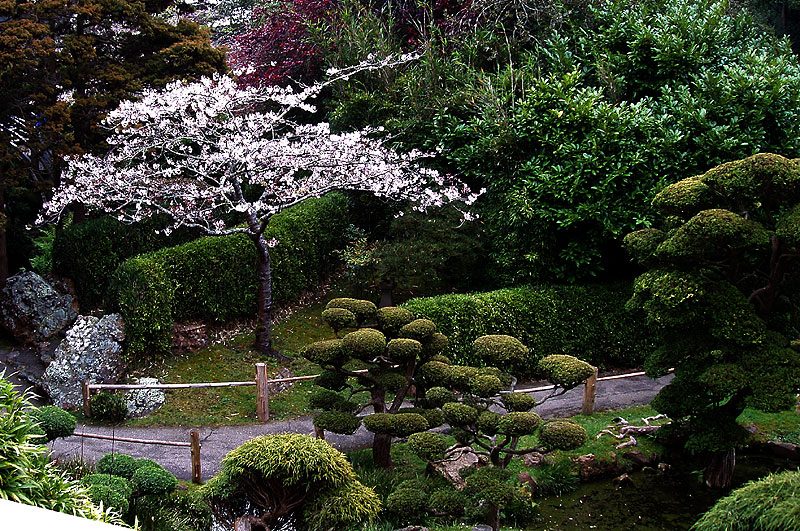
We headed up to Golden Gate Park to visit the de Young Museum last weekend. It was the latest in a long series of wet days. We stopped off first at the hundred-year-old Japanese Tea Garden next door. The cherry trees were blooming, the moss was thick and glistening in the rain, and the raindrops made rings in the ponds. The garden is a sublime example of creating art from nature. As you walk the paths, each turn creates a new picture, a composition of mossy rocks, water, pagodas, and plants, even incorporating the surrounding cypresses and pines. In contrast, the de Young museum is a brand new building, a completely rebuilt version of the old museum on the same site. The approach is along an unnecessarily narrow sidewalk hunched up against the external wall of the museum, which is a featureless monolith with no protective eaves. At the door, you are forced to stand in line in the rain to go through a security check. Once you are in, you can take a stairway down to the special exhibit area with steps which are too wide for a single step and too narrow for two so that you have to sort of limp your way down.

According to the museum's history page, the de Young, founded in 1895, was originally a curiosity cabinet of sorts, housed in an Egyptian style edifice.
During the next twenty years [de Young's] taste for the curious, intricate, and ornamental was reflected by acquisitions of painting and sculpture, arms and armor, fine porcelain, objects from South Pacific and American Indian cultures, including original art objects as well as reproductions. Visitors to the museum seem to have shared de Young's interest in such diverse objects as sculptures, polished tree slabs, paintings, a door reputedly from Newgate Prison, birds' eggs, handcuffs and thumbscrews, as well as two cases de Young had at last filled with a collection of knives and forks.

This ended in the 1930's:
[Longtime museum director] Dr. Heil chose to tactfully refuse personal keepsakes and household bric-a-brac, ending any perception of the de Young as the city's attic.
Pity. The city could use an attic!

In the early 1960's, the de Young decided to "de-accession" some of its holdings that were not part of its more modern focus on art, antiquities, and ethnographic artifacts. My dad, then a biology teacher at City College, was there, and picked up these two taxidermied birds, which are now part of the Zymoglyphic Museum's collection, creating a nostalgic link with museum history.

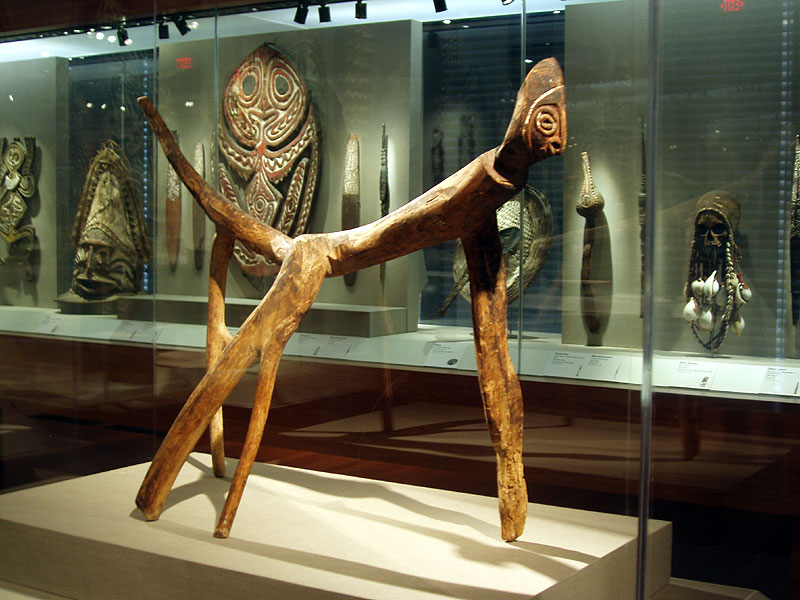
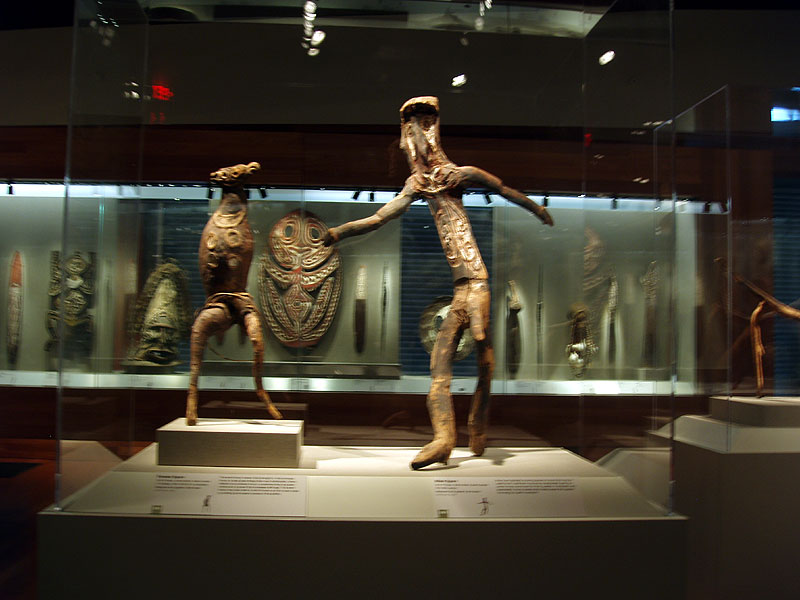
The evolution of the de Young is not all negative, however. It has always had an excellent collection of African, Oceanic, and Pre-Columbian artifacts and has recently acquired a large private collection of artifacts from New Guinea. This collection was the highlight of the trip. Shown here are "spirit figures" from Papua, dated at a few hundred years old. The label says:
Imunu are unique spirit figures obtained from the root of the Mangrove tree. A carver or spirit man dreams of an image and the goes to "find it" in the forest. A similar tradition is found among certain Inuit people, where the shaman dreams an image and then seeks it out among the driftwood on the beach

The collection is nicely documented in the book New Guinea Art: Masterpieces of the Jolika Collection from Marcia And John Friede

Saturday, March 25, 2006

A Traveling Crustacean Mini-diorama

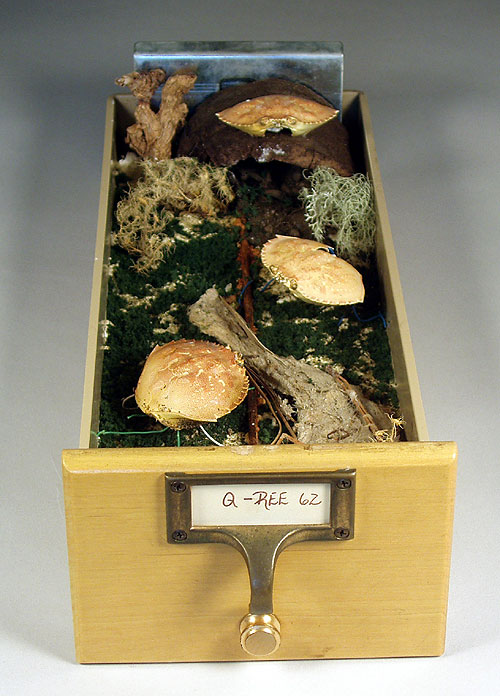
Last summer I was invited to participate in a project called The Curiosity Cabinet of the Collective Unconscious. The "cabinet" in question was an old library card catalog. Each participant got a drawer in which to create something having to do with the "collective unconscious". In mine, I ended up making a diorama featuring a little family of 3 crab carapaces in a wooded setting (shown here - click for larger view). I mostly work by just putting things together, often precariously, carrying them out to the museum, and possibly having to repair them when Open Studios rolls around. This was the first time that I had made something that needed to be shipped somewhere. The crabs had wires for legs, so they could be secured fairly easily, and the rest was glued or wired down. It was worth it to me to be part of a collaborative project, which was a welcome change for me.
The drawer had its debut with the rest of the cabinet at the Hive Gallery in August, which provided me with a good excuse to go down to L.A. for an extended weekend. The cabinet then traveled to Burning Man in September to become part of a funhouse that was installed in the base of the Man. The cabinet must have survived the inevitable fiery immolation of its host, as it has recently surfaced again at Create:Fixate in Los Angeles.

Sunday, March 05, 2006

Ferdinand Cheval and Le Palais Ideal


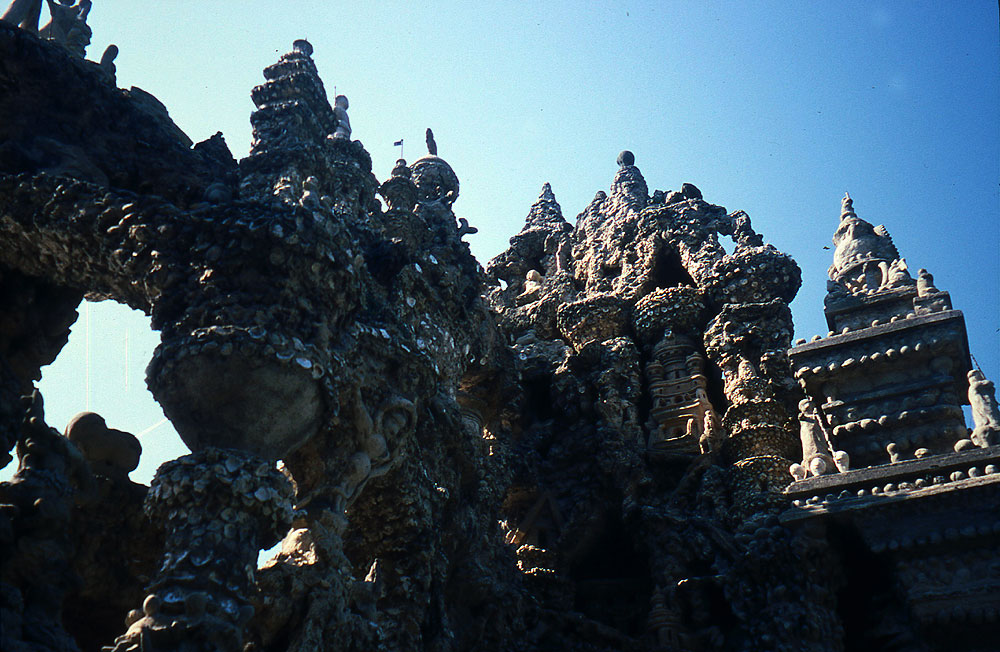
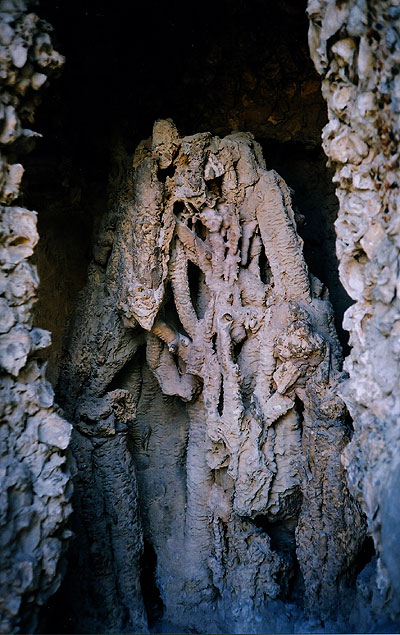
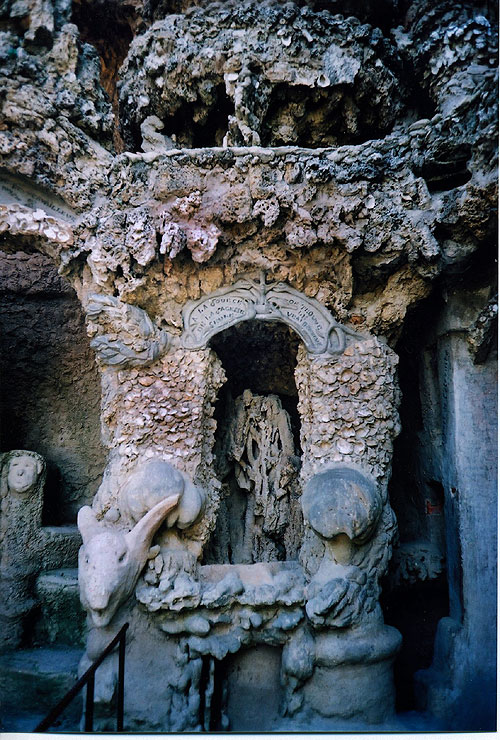
This entry was inspired by the Athanasius Kircher Society's "Visionary Architecture Week" and its coverage of the "Palais Ideal" in southeastern France. The palace was built by Ferdinand Cheval (1836-1924) over a period of some 33 years and it has been number one on my must-see list for many years. He built it using stones gathered on his rounds as a postman, as well as creating his own forms. I finally made a pilgrimage here in the fall of 2002. It is a wonder to behold. It contains a melange of architectural styles (real and imagined) with columns, arches, turrets, passageways, terraces, and giant statues. Inside and out are grottoes, galleries, rock gardens, and all manner of organic plant and animal creations emerging from it.

The Surrealists were fond of it, especially Andre Breton, who proclaimed Cheval as one of his own. Cheval has an entry in the Concise Encyclopedia of Surrealism which says, "The fantastic style of the palace...was often referred to by the Surrealists as an example of dream-life entering the real world."

A number of quotes from him were published in issue 38 of Raw Vision as an autobiography of sorts. He says:

I used to build a fairy-like palace [in my] imagination with all that the genius of a humble man could conceive (with grottoes, towers, gardens, castles, museums and sculptures) ...It so happened that just when my dream was gradually sinking in the mists of oblivion suddenly an incident brought it all back to me: I stumbled on a stone that nearly made me fall. I wanted to examine it closely, my stumbling block: its shape was so bizarre that I picked it up and took it away with me. The following day I went back to the same place and I found more beautiful stones which, gathered on the spot, looked so pretty and filled me with enthusiasm. Then I said to myself: ‘Since Nature provided me with sculptures I shall become an architect and a mason (besides who isn’t a bit of a mason?).'


Among the many details of the palace, one aspect that was of particular interest to me was his display of interesting stones. The inspiring "stumbling block" he mentions can be seen here, perched on a pedestal on an upper terrace, just as any viewing stone might be. A particularly intricate and organic rock has been framed in its own grotto like a religious icon. Some of the rocks which he found contained fossils and other pictorial elements. They are on display together in another nook as the "Museum of Antediluvian Stones".

A comprehensive and well-illustrated documentation of the palace is
Le palais idéal du facteur Cheval: Quand le songe devient la réalité (Collection "Les Bâtisseurs inspirés") (text in French). This book may also be found at amazon.fr.
Photographs shown here by Jim Stewart, copyright 2002
For more photos, see here
For visiting information, see the official site

Sunday, February 26, 2006

The Zymoglyphic Meteorite


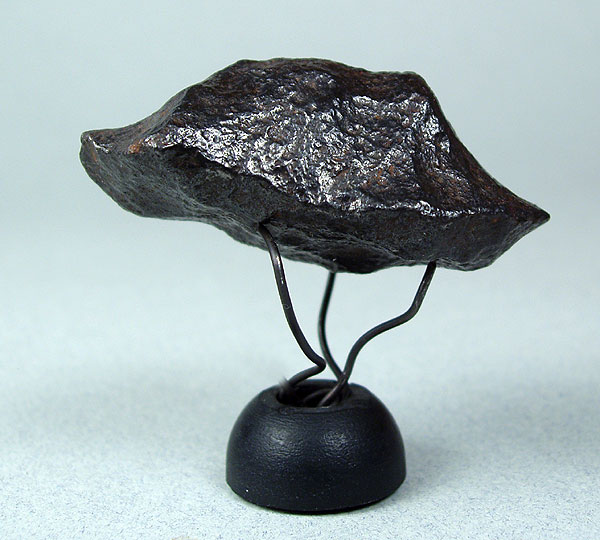
When I was a boy, I would troll the beach with a magnet tied to a long string, hoping to snag a torn-off bit of the cosmos in the form of an iron meteorite. As an adult, I found out that if you want one, you can just buy one. This one is from the Gibeon fall, a meteor that broke apart over Namibia in prehistoric times. It was originally part of the iron core of an asteroid that later broke up. Its melted, pitted exterior marks its fiery passage through the Earth's atmosphere, but its inner crystalline structure has not changed in 4 billion years. To me, it is the equivalent of a medieval relic, a connection to the universe and its creation.

One of the holiest relics of Islam (and its predecessors in Arabia as well) is a meteorite embedded in its central shrine at Mecca. One legend has it that this stone, too, dates from close to creation, falling at Adam's feet and subsequently discovered by Abraham.

The Hall of Meteorites in New York's American Museum of Natural History has an excellent exhibit (virtual and physical) on meteorites.

Monday, February 06, 2006

Mom's dream

My mother is now elderly and frail, but possesses a great independence of spirit. Her vision is failing and her world is getting smaller. She says she rarely remembers her dreams, but recently she told me of a particularly vivid one. She was in a museum with many rooms and great curving walls, but open to the sky. My brother and I were both there, about 10 years old. Lots of people were coming in, but no one was going out as there did not appear to be any exit. The museum was full of exquisite objects, absorbingly beautiful, even indescribable. When she looked around, my brother and I had gone, and she could not find us anywhere.

Sunday, January 22, 2006

Painting


In creating assemblage works from natural objects, I often think of having a sort of partnership, where I provide the overall idea and "let nature do the detail work". Natural objects often have a complex texture to them that remains interesting even at very close range. I started thinking that I could do some painting to make underwater diorama backgrounds - ideally the sort of atmosphere evoked by the paintings of Yves Tanguy (such as the one shown here). I took some classes on the basics of acrylic painting from Tesia Blackburn. I made some tiny paintings with interesting textures and became fascinated with making amoebas out of tar gel. The results are showcased in the Shoebox Art Gallery #3.


Last fall, I took a class at the Pacific Art League with Nancy Rice who makes large abstract paintings using a sort of pour-and-shake technique. I discovered that if I did something similar on Masonite board, the pigment deposit made an amazingly detailed pattern, consistent with my "let nature do the detail work" plan. I decided that some of the resulting paintings were interesting enough to be displayed on their own, and that the collaboration with natural processes qualified them as the Zymoglyphic art of the new millenium.

Sunday, January 15, 2006

The story of how the museum came to be


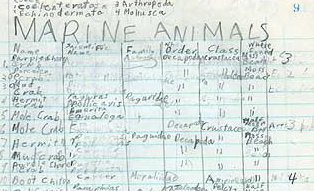
The museum's curator has been kind enough to submit a personal history of the Zymoglyphic Museum from its humble beginnings as a 10 year old's natural history museum and zoo to the vibrant melange that you see today. The catalog of holdings from that first museum still survives today, and a page from it is shown here.

-- The Museum Staff