Showing posts with label Photography. Show all posts

Tuesday, March 23, 2010

Obscura Day at the Museum


March 20, 2010 was Obscura Day, a set of 80 events around the world celebrating "wondrous, curious, and esoteric places". The day was sponsored by Atlas Obscura, an online compendium of such locations. The front men for the atlas are Joshua Foer (of the late lamented Athanasius Kircher Society) and Dylan Thuras (of the current and celebrated Curious Expeditions blog). A few of the museum's collections were presented in the Kircher Society's proceedings some years ago and the museum itself is currently listed in the Atlas Obscura.

The event was not publicized because it filled up early in February, much to the amazement of the museum's marketing department, which has struggled in vain for years to get people out to the wilds of San Mateo. Any potential patrons who missed out are reminded that the museum will be open again May 8th and 9th as part of Silicon Valley Open Studios.

There had been some concern on the part of museum management that visitors would be dropping by simply to gawk at something "eccentric" or perhaps just to be part of a trendy event . These fears proved unfounded as visitors showed genuine interest, as evidenced by the quality of the photographs taken. Samplings of these pictures have been gathered into galleries on the museum's Flickr page:

Zymoglyphic Museum Closeups
Photographers became absorbed in the details of the exhibits. Small components of the exhibits come alive in an amazing variety of ways in these pictures.

Zymoglyphic Dioramas
Kathryn Gritt came early, had the museum to herself for a good long while, and documented everything. She was especially successful at capturing the dioramas, which are a challenge to photograph well. Best of all, she produced two excellent little videos which capture the three dimensional qualities of the dioramas.

Hardly any visitors took pictures of themselves or others in the museum, so museum management has contributed a few documentary shots of the day that can be seen here

Friday, March 13, 2009

Spirits under glass


This past weekend saw a return to the de Young museum's ethnographic collections, first profiled here three years ago. This time I was armed with a new image-stabilized camera to meet the challenge of the museum's "no tripod, no flash" photography rules, with the results found here.
The collections are drawn from Africa, pre-Columbian Mexico, and especially New Guinea.
Most of these objects originally had specific roles in the spiritual life of the community. They have fascinated Westerners for centuries as strange objects from exotic realms. To some, they were grotesque pagan idols, representing ignorance and savagery, and to the Romantics a glimpse into a purer human, one more deeply connected to the basics of existence from which we as industrialized people have become alienated. Anthropologists collected, identified, classfied, and recorded these objects, as a biologist would do with natural specimens, and they are often still displayed in natural history museums. In the early modern era, artists, especially those connected with the surrealist movement, saw these object as having genuinely inspirational aesthetic qualities which could be appreciated independent of their spiritual function. Finally, oceanic imagery devolved into kitsch with the development of the Tiki culture.
One function of a museum is to try stop the passage of time, to preserve decaying things under bell jars or pickled in brine, bringing dead things back to life in dioramas, preserving the artifacts of the past. Encased in the sleekly modern architecture of the museum we see organic figurines, made of wood, clay, stone, or feathers, once living spiritual objects, extracted from dying cultures, forever frozen in action in their vitrines.

For another photographic perspective on this collection, see here.

The de Young's New Guinea collection is documented here

The Pitt Rivers Museum in Oxford contains a wealth of ethnographic artifacts in a Victorian setting. Its Web site offers a virtual tour

The Metropolitan Museum in New York City has a wonderful collection of African, Oceanic, and pre-Columbian artifacts, nicely documented here.

An excellent reference on the influence of "primitive" art on 20th century artists can be found here.

Wednesday, December 31, 2008

A Photogenic Metal Viewing Stone


Zhan Wang is a Chinese sculptor who has created a number of metal viewing stones in stainless steel, titled simply "Artificial Rock". He makes them by forming stainless steel over a selected rock, peeling away the metal, assembling the pieces into a hollow copy of the original stone, and polishing to a reflective shine. The result combines the complex forms and organic textures of the original stone with the sleek modernity of chrome.

Most of the artificial stones are one or two feet high, but there is one of monumental size in the de Young Museum's sculpture garden. Taking close-up photographs of the stone creates a sort of "found art". The rough texture creates a vertiginous funhouse mirror effect and, with no color of its own, the surface takes on the colors of the surrounding environment. Green patches are the reflection of surrounding vegetation, blue pools come from the sky, and the dark areas are shadows, often the photographer's own.

Zhan Wang has created his own series of similar photographs, an example of which can be found here.

Sunday, January 07, 2007

Stalking the Wild Tafoni


The museum has recently mounted expeditions to find and document a rare natural art form known as "tafoni". Tafoni is a type of rock on which weathering has produced a zymoglyphic result. The rock results from a combination of tectonic activity and our Mediterranean climate. San Mateo is very close to the San Andreas Fault, where two of the earth's major tectonic plates grind together. Crossing the Crystal Springs Reservoir into the hills to the west takes you across the fault, from the North American Plate to the Pacific Plate. Over the millenia, the seismic ferment has caused ancient sea beds to be pushed upwards and become land. In some places, fossilized remnants of these sea beds are exposed as isolated knobs of sandstone.
Once exposed, the weathering begins. The rock absorbs water during our wet season, dissolving calcium from ancient bits of sea shells. During the dry season, the evaporation of the water draws the calcium to the surface, resulting in an uneven erosion of the remaining rock. The result is an evocative combination of sinewy fretwork and miniature troglodyte landscapes.

These rocks can be seen at the "Sandstone Formation" on the Tafoni Trail in El Corte de Madera Creek Open Space Preserve and a number of locations in Castle Rock State Park. More expedition photos, and a graphic showing how tafoni forms, can be seen here. Tafoni also forms in rocks along the local beaches and some excellent photos of it by tafoni aficionado Dawn Endico can be seen here.

Further details on rock formations in the Bay Area

Sunday, November 26, 2006

Rosamond Purcell's Art from Decay


Rosamond Purcell has a long history of providing inspiration to the Zymoglyphic Museum as a photographer of museum specimens, a scholar of curiosities, an exhibit curator, a writer, and an assemblage artist of decay. Her photographs of natural history museum specimens earned her a place in the museum's Photographers of the Marvelous online photography exhibit, and her use of natural light in these pictures has been an inspiration to our own curatorial department's attempts to document our museum's collections. One of her collaborations with Stephen Jay Gould, Finders, Keepers: Eight Collectors, includes the story of Peter the Great's Kunstkammer in 18th century Russia, and, in particular, his acquisition of Frederik Ruysch's collection of anatomical dioramas and other preparations. The book includes Purcell's photographs of some of the few remaining Ruysch objects . Further research on curiosities and marvels led her to write Special Cases: Natural Anomalies and Historical Monsters, examing the historical significance of marvels.

In 2003, Purcell curated a traveling exhibit called Two Rooms. One room was a reconstruction of a small but historically important natural history museum created in the 17th century by Ole Worm. The other room featured a reconstruction of Purcell's own studio/museum, with walls of rusted metal sheets, a library of decayed, worm-eaten books, and arrangements of a variety of objects transformed by nature and weathering. Most of these objects came from a single source, a vast junkyard in Maine which she has been mining for aesthetic gold for two decades, and whose story is told in the book Owls Head

Her new book Bookworm: The Art of Rosamond Purcell finally showcases her photographs of her own found and created decayed objects. The range is a mix of weathered objects and textures, photographic collages, and assemblages constructed for the purposes of the photograph. Shown above is "Book for Fishes", combining a fish skeleton with an old, insect-eaten book found in a Harvard library. For a preview of the book, see the slideshow/review at Slate.com


There seem to be still more Zymoglyphic inspirations which have yet be fully documented. Above are two photographs from "Two Rooms", the exhibition catalog. The top one is a "miniature museum" from 1994, similar in spirit to the Zymoglyphic shoebox art galleries and the bottom shows a number of objects on display in her studio, any of which would be at home in our museum.

Sunday, October 15, 2006

From the Ancient Land of Happy Objects


A return trip to the de Young Museum in San Francisco turned up this fellow, a local emissary from Remojadas, the ancient Land of Happy Objects. Cheeky Pete was delighted to learn of this long-sought ur-object, the King of Happy Objects, but despite intense imaginary negotiations with the de Young curatorial staff, it was not possible for him to obtain the King for the museum's Happy Objects Collection. The King thus remains trapped in his plexiglass case. He is originally from the Veracruz area of Mexico, and is some 1300 years old. The Metropolitan Museum in New York has a cousin of his, and nervily suggests that his happiness is primarily due to intoxication.

The Remojadas culture had its "Classic" period between 500 and 800 AD, and produced a large number of "smiling figures". Further research by the curatorial staff has revealed the existence of a classic 1960 tome about the figurines produced in Remojadas: William Spratling's More human than divine: An intimate and lively self-portrait in clay of a smiling people from ancient Vera Cruz. Spratling was a collector, and waxes naively rhapsodic about the people who produced these figurines:
The little people of Remojadas flourished, loving their own creations, presumably in utter peace and contentment, for more than eight hundred years.

The main attraction of the book is the set of plates by Manuel Alvarez Bravo, a leading Mexican photographer often linked with the Surrealists. The photographs reveal that the figurines had a whole range of expression, not just smiling. The plates are classics of artifact photography.

Tuesday, August 29, 2006

The Quiet Parlor of the Fishes


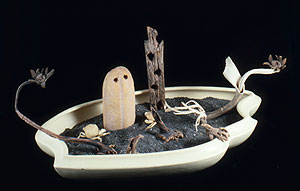
Late in the 1980's, before the Zymoglyphic Museum existed, I had an idea to make an aquarium, not with water, but a scene with a sandy bottom. This would be a big version of the surreal scenes in sandtrays that I had been making at that time. I was recently married then, and the theme was of two fish making a home in a strange world. I liked the idea that the result would be a piece of furniture you would have in your house, rather than a piece of art intended for a pedestal in a gallery. It was even rather practical, in that it would be very low maintenance for an aquarium. The aquarium was made of various things that I had found and had been given. My wife was making intricate hinged fish out of metal and plexiglass, and I thought an aquarium would make a nice home for some of them.

Even the title, "The Quiet Parlor of the Fishes", is a found object, taken from Thoreau's "Walden":

I cut my way through a foot of snow, and then a foot of ice, and open a window under my feet, where, kneeling to drink, I look down into the quiet parlor of the fishes, pervaded by a softened light as through a window of ground glass, with its bright sanded floor the same as in summer; there a perennial waveless serenity reigns as in the amber twilight sky, corresponding to the cool and even temperament of the inhabitants. Heaven is under our feet as well as over our heads.

"Walden" was one of my favorite books in high school. It provided a mythic and spiritual dimension to nature that transcended the mere collecting, naming, and classifying of specimens, which had been the focus of my original museum. The summer between high school and college, I even tried a brief emulation of Thoreau's year-long stay at Walden pond. I camped out by myself for four days on an island in the middle of a small mountain lake in Olympic National Park. I paddled out to the island on a primitive boat made by tying driftwood logs together, read Walden, and wrote a short journal, trying to emulate Thoreau's 19th century style.


In this dry aquarium, the two fish have a little television set in their parlor and are watching a program that features one of the Judy's art-fish. They also have their own little dry aquarium, foreshadowing the worlds-within-worlds theme of the museum-to-come. This first aquarium was followed by a series of small dioramas inside standard 10-gallon aquariums. Some had a terrestrial theme and some were aquatic. The serenity of the underwater world, eternal and unchanging, gave way to the archetype of the primordial ooze, a crowded, dense, active, messy world of creation, decay, and conflict, and a Walden-like mythological cycle of death and rebirth.


In recent years, I have been trying to capture a sense of the little worlds inside the dioramas in close-up photography and I think this is one of the more successful attempts. It is the little aquarium in fishes' parlor. This picture was, in fact, my entree into hallowed halls of the Museum of Dust.


In the past couple of months, Judy has been experimenting with pinhole photography, using homemade mini-cameras. I was not convinced of the true potential of this technique until she took some photos of the aquarium, which gave the whole thing a dreamlike air. The full set of photos can be seen here. One of the those photos, of an astronaut from the moon who is coming to visit the fish, resulted in her own initiation into the Museum of Dust.

Saturday, June 17, 2006

Andy Goldsworthy's Collaborations with Nature

As I noted last week, in David Attenborough's documentaries, the natural world is teeming, bizarre place of baroque mating rituals, predation, and survival. A more bucolic view of nature is one that looks at the beauty in natural forms and patterns. One of the themes in Zymoglyphic culture is making art from natural objects, often with minimal transformation. Andy Goldsworthy is the purest Western practitioner of the craft of arranging natural materials into art forms. Usually, it is a matter of lightly imposing some human abstraction - a circle, spiral, or an unnatural crack - in a natural landscape to somehow achieve a magical effect. Some of his creations are permanent installations in stone, but most are ephemeral structures of ice, leaves, water, sticks or the crackles in drying mud. For these, his photographs become the final creative product and only remaining evidence of the work. The photographs in turn are available in a series of high-quality books. A good survey is Andy Goldsworthy: A Collaboration with Nature.

A lesser-known type of work that he does are "snowball paintings", which are created by putting a snowball stained with a natural dye on paper and letting it melt. The result is an amazingly detailed pattern created by the way the dye is deposited as the snow melts and the water evaporates. A detail from one is shown here, with an enlargement here. The Zymoglyphic acrylic paintings achieve a similar effect from the deposition patterns of the (unnatural) acrylic pigment.

An additional dimension to Goldsworthy's work is provided in the excellent documentary Rivers & Tides, which shows his work in a context of time and motion that you don't see as much in the still photographs. A pile of sticks by the shore is demolished bit by bit by the tides; a string of leaves snakes its way lazily down a creek.
He has two permanent installations in the Bay Area. One is Stone River in front of the Cantor Arts Center on the Stanford University campus, and the other
is at the de Young Museum in Golden Gate Park.

Saturday, February 11, 2006

Karl Blossfeldt


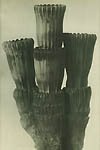
Neva Beach has graciously donated to the museum 13 prints from the 1929 edition of Karl Blossfeldt's Urformen der Kunst, along with a nice assortment of rusty metal and gnarly driftwood. Blossfeldt is featured in the museum's Photographers of the Marvelous online exhibit. The Blossfeldt prints form a major enhancement to the museum's photography collection. An online version of the book may be seen here. Blossfeldt's photography has been an inspiration to the museum's staff photographer, who envies Blossfeldt's ability to give a monumental, architectural presence to small scale natural objects - a major goal in photographing, for example, the museum's small dioramas and viewing stones.
An excellent book: Karl Blossfeldt: 1865-1932 (Photo Book Series)

-- The Museum Staff