Tuesday, August 29, 2006

The Quiet Parlor of the Fishes


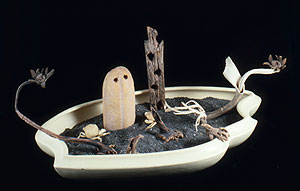
Late in the 1980's, before the Zymoglyphic Museum existed, I had an idea to make an aquarium, not with water, but a scene with a sandy bottom. This would be a big version of the surreal scenes in sandtrays that I had been making at that time. I was recently married then, and the theme was of two fish making a home in a strange world. I liked the idea that the result would be a piece of furniture you would have in your house, rather than a piece of art intended for a pedestal in a gallery. It was even rather practical, in that it would be very low maintenance for an aquarium. The aquarium was made of various things that I had found and had been given. My wife was making intricate hinged fish out of metal and plexiglass, and I thought an aquarium would make a nice home for some of them.

Even the title, "The Quiet Parlor of the Fishes", is a found object, taken from Thoreau's "Walden":

I cut my way through a foot of snow, and then a foot of ice, and open a window under my feet, where, kneeling to drink, I look down into the quiet parlor of the fishes, pervaded by a softened light as through a window of ground glass, with its bright sanded floor the same as in summer; there a perennial waveless serenity reigns as in the amber twilight sky, corresponding to the cool and even temperament of the inhabitants. Heaven is under our feet as well as over our heads.

"Walden" was one of my favorite books in high school. It provided a mythic and spiritual dimension to nature that transcended the mere collecting, naming, and classifying of specimens, which had been the focus of my original museum. The summer between high school and college, I even tried a brief emulation of Thoreau's year-long stay at Walden pond. I camped out by myself for four days on an island in the middle of a small mountain lake in Olympic National Park. I paddled out to the island on a primitive boat made by tying driftwood logs together, read Walden, and wrote a short journal, trying to emulate Thoreau's 19th century style.


In this dry aquarium, the two fish have a little television set in their parlor and are watching a program that features one of the Judy's art-fish. They also have their own little dry aquarium, foreshadowing the worlds-within-worlds theme of the museum-to-come. This first aquarium was followed by a series of small dioramas inside standard 10-gallon aquariums. Some had a terrestrial theme and some were aquatic. The serenity of the underwater world, eternal and unchanging, gave way to the archetype of the primordial ooze, a crowded, dense, active, messy world of creation, decay, and conflict, and a Walden-like mythological cycle of death and rebirth.


In recent years, I have been trying to capture a sense of the little worlds inside the dioramas in close-up photography and I think this is one of the more successful attempts. It is the little aquarium in fishes' parlor. This picture was, in fact, my entree into hallowed halls of the Museum of Dust.


In the past couple of months, Judy has been experimenting with pinhole photography, using homemade mini-cameras. I was not convinced of the true potential of this technique until she took some photos of the aquarium, which gave the whole thing a dreamlike air. The full set of photos can be seen here. One of the those photos, of an astronaut from the moon who is coming to visit the fish, resulted in her own initiation into the Museum of Dust.

Monday, August 28, 2006

U.S. Postage Stamp Honors Shop Customers!


The U.S. Postal Service has issued this stamp featuring the first and so far only people known to have purchased Zymoglyphic-branded apparel from the museum shop. This daring couple plunged into unknown retail waters some 2 1/2 years ago and are now rewarded with owning a pearl of great rarity, as well as being thrust into the avant garde of the fashion world. The resale value of rare Zymoglyphic merchandise is literally incalculable as none has as yet been offered for sale. The couple's name is being withheld in order to forestall any rumors that the shop has yet to make an apparel sale outside the curator's immediate family.

-- Museum Shop Marketing Dept.

Sunday, August 13, 2006

Kaolithic Curiosities at the Wonders of the World Museum

I don't recall exactly what drew me to Port Costa in the late 1970's. It's a tiny town in the outer reaches of the Bay Area, on the road to nowhere else, on a bank of the Sacramento River. Downtown consisted of some old buildings, a relatively large restaurant/bar popular with bikers, and a few antique store/curiosity shops. My attention, however, was immediately drawn to a storefront that housed the Wonders of the World Museum ("Stands Alone on Earth"), presided over by one Dr. George Gladstone.

Wonders indeed. There were many fascinating exhibits, many of which dated from the Pre-Credulous Era of the Bone Age, when fossils metamorphosed into ceramic instead of rock by a process known as Kaolism. Hominids in that age came in a huge variety of sizes. There was an 8-foot high Bigfoot with a triple-jointed penis bone, whose variety of functions Dr. Gladstone described in detail, and a numerous lilliputian race dubbed Homo Ceramicus. Two skulls of the latter were later acquired for the Zymoglyphic Museum's curiosity cabinet. Shown above is a rockpecker, whose skull could be used as stone-shaping tool. As a complement to the fossilization process of Kaolism, I learned how life can be created from mud, albeit with some unusual results.

The visit turned out to be good timing, because the museum was only in existence for a few years. It left a lasting impression on me, though, and when I finally had my own museum, I thought I would seek out the man behind Dr. Gladstone, Clayton Bailey. Three years ago, in July of 2003, I contacted Clayton via e-mail and he was gracious enough to give me a tour of his studio. He still lives in Port Costa, behind a fence topped by ceramic gargoyles of his own making. The big studio contains a large herd of robots, all of which are descended from a single robot originally designed to retrieve specimens for the museum from outer space. Instead, that first robot took over Clayton's brain and commanded him to create more robots. The Kaolithic Curiosities are now resting picturesquely in the yard (see above), maybe to be re-excavated and analyzed by a future generation.

Although seen by some as a "mad scientist", Dr. Gladstone's archaeological research methods have been an inspiration to the Zymoglyphic Museum curatorial staff.

Check out the Ceramic Wonders, especially the face jugs

More photos from 2003

Reference book: Clayton Bailey: Happenings in the circus of life

Wednesday, August 09, 2006

World's Smallest Viewing Stones Made From Cosmic Dust


Our director at the Museum of Dust has recently acquired a lovely speck of cosmic dust, and those clever guys in the Zymoglyphic Museum's curatorial department have mounted it as a viewing stone, carrying "miniature" to its logical extreme. The curator has gone the director one better by finding an even smaller cosmic mote, this one a scant eight micrometers high (below). I will leave it to Dir. de Plume to figure out how exactly to incorporate these prizes into the MoD bonsai garden. Obviously they won't take up much room!


Original cosmic dust grains from J. Freitag and S. Messenger via LiveScience.com (top) and D. Brownlee and E. Jessberger via Wikipedia (bottom)

Saturday, August 05, 2006

A Mysterious Document Surfaces

The Zymoglyphic Museum has somewhat of a reputation as a "museum of decay" (undoubtedly a factor in its recent targeting by the Museum of Dust). A mysterious document has recently surfaced that may or may not help explain the origins of this phenomenon. This loose notebook page was found deep in the curator's personal archives. It appears to be the record of some sort of archeological dig, apparently in his closet. The manual timestamp on the document indicates that the dig was most likely in preparation for leaving home and heading off to college a continent away.

Here is a literal transcription of the document:

2 very stale pieces of bread w/casts of pupae, presumably carpet beetles, as dead same found there also. Open can, no mold on bread
Cardboard can w/mistletoe, dead and moldy
Separate substance so moldy as to be unrecognizable
Piece of wrapped cheese, brown liquidy and stinking like hell
Dried leaf of lichen, brown but not moldy
Plastic dish with spoon and white powder
Nylon plankton net
Mold on plate under glass, indicating square outline of something that had been there. No smell.
Jar with moldy prunes - now only moldy pits are left & some gunk on sides & bottom of jar. No smell. Rotting for many years
Old spider nests in jars found in closet - explains spiders in here. Jar w/bread(?) explains beetles. Now how did sow bugs get in here?

Saturday, July 29, 2006

Surrealist Barbie

In primitive societies, there are often particular figurines considered to have great power within the culture. For us, the Barbie doll seems to serve that function. Such is the power of this figurine that she has managed to stay trendy for more than 50 years in the ever-changing worlds of fashion and toys. She has even penetrated the august halls of the Zymoglyphic Museum, where current events are rarely acknowledged and brand names hardly ever seen.

My niece went through a fairly heavy Barbie phase in her pre-teen years. One Christmas when we were visiting, she presented me with this rearranged doll which is now enshrined as the ultra-rare Surrealist Barbie of the museum's curiosity cabinet. It is still exactly as she gave it to me. Later, she sent me some heads and a few body parts for me to use in art projects (see note below). Then, no doubt inspired by her visit to the museum, she created Nude Barbie-zilla.


It turns out that deconstructing Barbies is practically a cottage industry. The prevalence of girls mutilating their Barbies in various ways was the subject of a recent study at the University of Bath. The Market Street Gallery in San Francisco hosting the fourth annual Altered Barbies show with more than 50 artists participating. It runs through August 27th.

Sunday, July 23, 2006

A Fictocryptic Museum

The Museum of Jurassic Technology has recently been enmeshed in the Museum of Dust's acquisition spree (a fate which befell the Zymoglyphic Museum not so long ago), with the MoD director proclaiming the MJT to be the "grandparent of all modern fictocryptic establishments".

I had heard about this museum for many years and had seen some of its traveling exhibits. I finally was able to visit it in person when I went to Los Angeles last August. The museum is often referred to as a "curiosity cabinet", which is generally a haphazard collection of interesting stuff, but the MJT model is really more an instructive academic museum with professional-looking exhibits, each examining some esoteric phenomenon in great detail. In this museum, however, the phenomena described may or may not be fictional, and the way the line is straddled is subtle enough to keep you guessing even when you know what is going on. The book Mr. Wilson's Cabinet Of Wonder: Pronged Ants, Horned Humans, Mice on Toast, and Other Marvels of Jurassic Technology details one writer's attempt to cut through the fog of uncertainty surrounding the museum. It is, in a way, a highly rarefied version of a circus sideshow, where some of the freaks are real and some are not, but what really matters is the atmosphere created.

"Is this place real or what?"
"It's here, isn't it?"

--Conversation overheard at the MJT, October 2000, quoted in this article

To me, the fascination of the MJT is the pure physical presence of the place, its dark lighting, well-crafted vitrines, surreal dioramas, and labyrinthine exhibit rooms, including a theater and a tea room. The image above is from a Flickr photoset of the MJT by The Blen that gives you a good sense of what the museum is like. It's interesting to compare the MJT with Steven Millhauser's Barnum Museum which, being made entirely of words, is not subject to any physical laws.

While not truly an inspiration for the Zymoglyphic Museum, there has been some pollination wafting our way from the southland. The physical existence of the Zymoglyphic Museum is important, in that it exists in a geographic location and has real objects in it, but there is more of an emphasis on outreach through photography and web presence than on perfecting the physical exhibit space. The Lower Jurassic is much more technologically oriented than the Zymoglyphic culture, which tends toward rust and decay anyway. The Zymoglyphic Museum, like the MJT, has sometimes been accused of lax standards in the factual accuracy of its presentations (which it can neither confirm nor deny), and both may ultimately turn out to be physical manifestations of the internal worlds of their creators.

Saturday, July 22, 2006

Museum Shop - Staff Announcement

The Zymoglyphic Museum Shop is pleased to announce a new addition to its staff. Cheeky Pete the Clown is now in charge of the shop's drinkware division. He comes to the museum through the joint good graces of Shad McConnell of Portland, Oregon, and Judith Hoffman, of San Mateo, California, to whom the museum is greatly indebted. Mr. Clown faces a considerable challenge as the museum shop has not as yet sold a single mug or stein. However, we believe his seemingly eternal optimism will help to turn the situation around, preferably a full 360 degrees. In addition, we are confident that staff and patrons will now refrain making insensitive references to "those clowns running the shop". Visitors to the museum may rest assured that, like many celebrities, Mr. Clown is much smaller in person.

-- The Museum Staff

Monday, July 10, 2006

Natural Modernism in Sculpture


Recent posts here on Andy Goldsworthy and Hubert Duprat have covered collaborations between nature and people to make art. This is a common theme in Zymoglyphic culture, where the motto for artists is "Let nature do the detail work." The sculptures shown here are a collaboration among a boring clam (boring in that it drills holes, not that it is uninteresting), the sea, and a human eye and hand to select and arrange the results. The clam in question (a specimen from the museums's collection is shown here) is also known as a piddock. It is more torpedo-shaped than clam-shaped and has the ability to rasp its way into rock using the ridges on its shell and a rotating motion. It uses the holes it creates for protection. When the rock is broken up by erosion (often aided by the weakening of the rock by the clam holes themselves), the resulting fragments are worn smooth by wave action and cast up on the shore. The results often bear an uncanny resemblance to that archetype of modernist sculpture, the 3-dimensional free-form blob with one or more holes in it. These are prized by Zymoglyphic collectors. Some the museum's specimens of this type of natural art are featured in the Shoebox Art Galleries 1 and 2. Two of those sculptures have been gathered here for the group portrait; the rest are making their internet debut.

These sculptures can be seen as Modern Age descendants of the miniature viewing stones that were so popular during the Zymoglyphic region's Era of Oriental Influence. The boring clams themselves have their place alongside the Xenophora in the Zymoglyphic pantheon of molluscan artists. The clams are seen as true "sculptors", rather than, like the Xenophora, assemblers of found objects.

Thursday, July 06, 2006

"Designer" Jewelry with Insect Larvae


Caddis flies live near ponds and streams. As larvae, they live underwater and make wearable tubes from local materials, such as twigs, sand, stones, or snail shells. The items they select are bound with silk and the larva hooks itself inside with the end of its abdomen. They are thus candidates for our stable of "natural assemblage artists" which include the bowerbirds and the Xenophora. The tubes serve various purposes - stones can be added to increase traction in fast-moving streams; irregular twigs make the tube (and its inhabitant) difficult for a trout to swallow. This may be considered more engineering than artistry, but in this case nature has a human collaborator. French artist Hubert Duprat has developed a method of getting the larvae to use more upscale materials, such as gold flakes, pearls, and sapphires, which would of course have no practical benefit in the wild and thus gets much closer to "art". Here is an interview with the artist as he describes the process in detail, and he and an art critic discuss whether there is actually a creative contribution from the insect in this "collaboration".

Here are some examples of what the caddis fly larvae build on their own:


from Scotland's Hunterian Museum Animal Architecture Collection


From the book Animal Artisans