Saturday, July 02, 2011

Skip's Museum

The second most frequently asked question from visitors to the museum (after "What does 'zymoglyphic' mean?") is "How long have you been doing this?" The long answer involves a tale of a childhood museum, collections of bird nests, shells, rocks, stamps; decay; changing interests; back to collecting again and eventually the resurrection of the museum. That story can be found in more detail here.

Near the outset of Kurt Vonnegut's 1959 novel The Sirens of Titan, Malachi Constant, the richest and luckiest man in America, visits Winston Niles Roomford, a similarly wealthy space traveler who is caught in a "chrono-synclastic infundibulum," spread out across space and time but on occasion materializing in his palatial home. The visit occurs during one of these materializations and includes the following vignette as part of the tour Roomford gives Constant:
[ Roomford] led the way down a back corridor and into a tiny room hardly larger than a big broom closet: It was ten feet long, six feet wide, and had a ceiling, like the rest of the rooms in the mansion, twenty feet high. The room was like a chimney. There were two wing chairs in it.
"An architectural accident —" said Rumfoord, closing the door and looking up at the ceiling.
"Pardon me?" said Constant.
"This room," said Rumfoord. With a limp right hand, he made the magical sign for spiral staircase. "It was one of the few things in life I ever really wanted with all my heart when I was a boy — this little room."
He nodded at shelves that ran six feet up the window wall. The shelves were beautifully made. Over the shelves was a driftwood plank that had written on it in blue paint: SKIP'S MUSEUM.
Skip's Museum was a museum of mortal remains — of endoskeletons and exoskeletons — of shells, coral, bone, cartilage, and chitin — of dottles and orts and residua of souls long gone. Most of the specimens were those that a child — presumably Skip — could find easily on the beaches and in the woods of Newport. Some were obviously expensive presents to a child extraordinarily interested in the science of biology.
Chief among these presents was the complete skeleton of an adult human male.
There was also the empty suit of armor of an armadillo, a stuffed dodo, and the long spiral tusk of a narwhal, playfully labeled by Skip, Unicorn Horn.
"Who is Skip?" said Constant.
"I am Skip," said Rumfoord. "Was."

"...dottles and orts and residua of souls long gone" has become a favored phrase in the museum's PR department. A dottle is the "wet and sour-smelling mass of unburned tobacco found at the bottom of a tobacco pipe." The Zymoglyphic Museum does not actually possess any known dottles in its holdings, but some of its more indefinable artifacts could plausibly be confused with them.

Sunday, April 24, 2011

Open Days at the Museum - First 2 weekends in May!

The Zymoglyphic Museum will be open for TWO weekends this year, May 7-8 and  May 14-15 as part of Silicon Valley Open Studios from 11 AM to 5 PM each day.  This year the studio of noted metal and book artist Judith Hoffman will also welcome visitors at the same location.  Details here.

Obscura Day
The museum's overwinter accumulation of dust and cobwebs were stirred earlier this year when the museum was open for Obscura Day 2011.  Visitors were encouraged, as usual, to take photographs, with the following results:
      Flickr user Microecos found some interesting hidden details in and around the museum
      Stephanie Theune led an expedition into wildest suburbia

Open Studio Enticements
The museum shop will be in full swing, offering:
    The official guide to the museum
    A book of engraving collages purporting to be views of the Zymoglyphic region
    Prints of said engraving collages
    A book of quick sketches also claiming to be views of the region
The museum has also acquired an intriguing bit of conceptual art from PreNeo Press which may (or may not) assist  befuddled visitors in finding meaning in the museum.
A special exhibit will showcase the dreamy pinhole photographs of the museum made by Judith Hoffman during her tenure as artist-in-residence at the museum, as well as the homemade camera used to take the photographs.

Making Your Own Museum
In Kurt Vonnegut's novel The Sirens of Titan, one of the main characters had a childhood museum,  described as "a museum of mortal remains — of endoskeletons and exoskeletons — of shells, coral, bone, cartilage, and chitin — of dottles and orts and residua of souls long gone."  Zymoglyphic Museum visitors often mention their own accumulations of detritus and effluvia, perhaps bones, rusty objects, memorabilia, or flea market finds.  A new museum publication, Creating and Curating Your Own Museum guides budding curators in the process of turning these raw materials into a personal museum.  Copies will be available in the museum shop or may be downloaded in PDF format here

Sunday, March 27, 2011

Obscura Day II


The Museum will be open to the public April 9, 2011, from 11 AM to 5 PM as part of Obscura Day 2011, sponsored by Atlas Obscura! "A day of expeditions, back-room tours, and hidden treasures in your hometown," assuming your hometown is one of the 80+ event locations around the world. The Atlas Obscura is an online compendium of "the world's wonders, curiosities, and esoterica", a designation of which our humble museum has been deemed worthy (readers may decide for themselves whether the museum is wondrous, curious, and/or esoteric).

This particular museum tour is limited to 60 participants and sold out last year - sign up here. For some insight on what to expect, you may refer to last year's entry, Obscura Day 2010. Photography is encouraged; photographs uploaded to Flickr (suitably tagged) are eligible to be showcased in the museum's Flickr galleries. Books from the Zymoglyphic Museum Press will be available for purchase.

Saturday, October 02, 2010

Two New Books and a Book Arts Jam


The Zymoglyphic Museum Press is pleased to announce the publication of a much-expanded and revised second edition of the official museum guide.  This new edition includes a trenchant and erudite introductory essay by Peter Frank, ruminating on the Zymoglyphic ethos regarding nature, art from nature, and the nature of art.  Peter is the art critic for the Huffington Post and Adjunct Senior Curator at the Riverside Art Museum in Riverside, California.

"Sketches of the Zymoglyphic Region" is brand new booklet containing twenty recently discovered drawings from the Modern Age of the Zymoglyphic region. Inhabitants of the region were encouraged to fan out across the countryside and capture its wonders in quick, spontaneous strokes.  The enigmatic results have been gathered here for the first time and are made available to the public at large.

Both books, along with an updated "Views of the Zymoglyphic Region" (a book of engraving collages), will be available for perusal and purchase at the Book Arts Jam on Saturday, Oct. 16, 2010 from 10 AM to 4 PM at Foothill College in Cupertino, California. A sampling of artifacts from the museum will be on hand, as will the curator.

The Book Arts Jam is an annual event put on by the Bay Area Book Artists.  The show features one-of-a-kind artist-made books, as well as self-published items, mail art, and materials that you can use to create your own books.  In addition, there will be exhibits, demonstrations, and talks pertaining to the book arts. Admission is free; parking is $2.

If you are unable or unwilling to attend the jam, you may purchase or download books online through the museum shop.  Peter's essay is available as a download here

Saturday, August 21, 2010

Visions of Alice


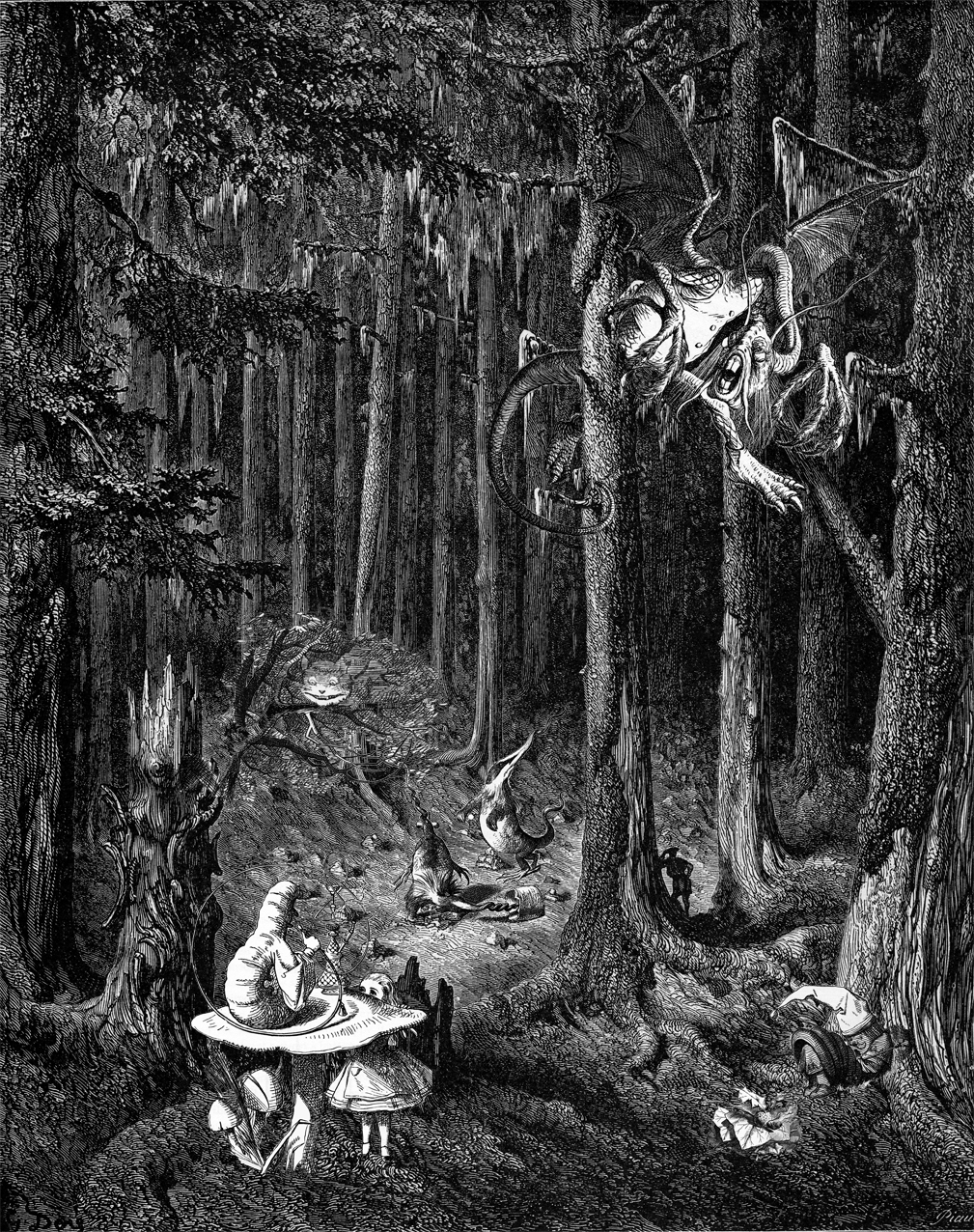
Deep in the tulgey forest, Alice receives some confounding advice from the Caterpillar whilst a pair of slithy toves gyre and gimble. Nearby, resting in a sunny spot, is a Snap-dragon-fly, "its body made of plum-pudding, its wings of holly-leaves, and its head a raisin burning in brandy". The Red Knight is snoozing against a tree. The Jabberwock is trying to get some attention, but no one wants to awaken the Red Knight, since they are all phantoms of his dream.

Herewith we present a commemorative collage from the museum's publications department, featuring an arrangement of some of John Tenniel's original illustrations, set in a "tulgey wood" provided by Gustave Dore. Most of the collages in this series are views of the Zymoglyphic region, which, in fact, is not very far from Wonderland. See a previous blog entry for more of Alice's influence on the region.

A blockbuster version of the Alice story recently hit the big screen, transforming two complex, multi-level tales into a conventional battle of good vs. evil, albeit with eye-popping visuals. The museum's marketing department had advised us to cling tight to its coat-tails to promote this print, but the blog department was, like the White Rabbit, late. The print is nevertheless available in various sizes and framing options here

This collage was recently featured at Alicenations, one of the blogs maintained by Adriana Peliano of the Sociedade Lewis Carroll do Brasil. Adriana also creates amazing assemblages and collages inspired by the Alice stories, as well as traditional tales.

Two other Lewis Carroll societies exist, in the U.S. and the U.K, both tending toward somewhat more academic pursuits. This is perhaps the most interesting part of Carroll's legacy - that a synthesis of mathematical logic, wordplay, dream logic, storytelling invention, and a timeless view of childhood can inspire an apparently inexhaustible variety of movies, art, plays, and scholarly analysis.

Tuesday, May 25, 2010

A Tumultuous Week at the Museum


The Zymoglyphic Museum's news desk is a sluggish thing, and is only just now getting around to reporting the events of the week beginning May 8th. The week opened with a very successful Open Day on that Saturday. Visitors converged from far and wide, including a pair who bicycled down from San Francisco, and others who came from Alameda, Berkeley, Mount Madonna, and possibly even further. Sunday morning came down with unseasonable rain coupled with a burst pipe in the exhibit preparation area, but the rest of the day went well, and included an impromptu Mother's Day tea in the museum's forecourt. One visitor sported a fine octopus tattoo based on an Ernst Haeckel design. Haeckel was an artist/scientist whose work features prominently in the Views of the Zymoglyphic Region.

During all this commotion, an uncommonly bold Bewick's wren was constructing a nest in the base of Scholar Monk's tree in the museum forecourt. He (the male builds the nest, subject to approval by the female) busily gathered sticks many times his own size, bits of moss, wool (provided by museum staff), and dry leaves, and assembled his homestead. Our stealthy museum photographic staff captured some of the activity.

Finally, late the next Friday night, while we dozed unawares, an alleged miscreant was apparently trapped by police in the cul-de-sac and an ensuing fracas toppled much of the museum's forecourt, leaving splotches of blood on the driveway among the deconstructed art. Authorities have been tight-lipped about what actually transpired, and the structures are now mostly resurrected. The pot that contained the wren's nest was crushed, but fortunately it was unoccupied. Presumably the female wren had vetoed the location some days before and is now chirping the wren equivalent of "See? I TOLD you!!". We hope they are happily ensconced in a less chaotic location.

Sunday, April 25, 2010

Annual Open Days at the Museum


Continuing the time-honored, late-spring tradition, the museum will again open its doors to the public as part of Silicon Valley Open Studios. Potential patrons who were unable to secure tickets for Obscura Day have been granted a second chance, and other curiosity seekers will be welcomed. Visitors old and new will want to recommend the museum to their contacts, friends, acquaintances, followers, fans, correspondents, and any other such relationships that they may currently have.

Previous visitors should note that there will be the following NEW features this year:

- A newly remodeled forecourt, featuring the Garden of the Four Monks
- A display of prints from the Views of the Zymoglyphic Region series. Copies of the book will be available for sale on site.
- Sketches of the region, fresh from the curator's notebook, fleeting impressions captured in slapdash but intriguing pencil drawings.

Copies of the museum's Guide Book will be available for sale at a slight discount, and the curator will of course be available to help solve any museum-related mysteries (although there are no guarantees of satisfactory answers). Photography is encouraged and selected results will be highlighted by inclusion in one of the museum's Flickr galleries.

Directions may be found here. Those who are internal-combustion-challenged should note that the museum is a 10-15 minute walk from the Hillsdale train station.

Tuesday, March 23, 2010

Obscura Day at the Museum


March 20, 2010 was Obscura Day, a set of 80 events around the world celebrating "wondrous, curious, and esoteric places". The day was sponsored by Atlas Obscura, an online compendium of such locations. The front men for the atlas are Joshua Foer (of the late lamented Athanasius Kircher Society) and Dylan Thuras (of the current and celebrated Curious Expeditions blog). A few of the museum's collections were presented in the Kircher Society's proceedings some years ago and the museum itself is currently listed in the Atlas Obscura.

The event was not publicized because it filled up early in February, much to the amazement of the museum's marketing department, which has struggled in vain for years to get people out to the wilds of San Mateo. Any potential patrons who missed out are reminded that the museum will be open again May 8th and 9th as part of Silicon Valley Open Studios.

There had been some concern on the part of museum management that visitors would be dropping by simply to gawk at something "eccentric" or perhaps just to be part of a trendy event . These fears proved unfounded as visitors showed genuine interest, as evidenced by the quality of the photographs taken. Samplings of these pictures have been gathered into galleries on the museum's Flickr page:

Zymoglyphic Museum Closeups
Photographers became absorbed in the details of the exhibits. Small components of the exhibits come alive in an amazing variety of ways in these pictures.

Zymoglyphic Dioramas
Kathryn Gritt came early, had the museum to herself for a good long while, and documented everything. She was especially successful at capturing the dioramas, which are a challenge to photograph well. Best of all, she produced two excellent little videos which capture the three dimensional qualities of the dioramas.

Hardly any visitors took pictures of themselves or others in the museum, so museum management has contributed a few documentary shots of the day that can be seen here

Sunday, February 14, 2010

27 Views of the Zymoglyphic Region


A previous post somewhat prematurely announced the discovery of a number of historical views of the Zymoglyphic region. Many more of these views have since surfaced and are now available in book form from the museum shop. You can also order individual poster size prints, framed or unframed. A generous sampling of the views may be seen here.

These views show the natural history of the area and scenes of daily life in its villages, woods, and jungles, beginning with the wet, humid, lowlands where Rust Age customs still hold sway, moving through the mountainous uplands, and finally entering the buzzing capital city at its center, as well as some of the more remote wonders on the region. Its people are engaged in creative, if often enigmatic, activities, in a landscape of strange and strangely familiar creatures, chimeras, and spirits.

Our resident Scholar Monk has discovered that these supposed documents are but fevered dreams, cobbled together from various European engravings whose sources have been tracked down. Most of them date from northern Europe's Age of Wonder, a world of extravagant architectural excess, grotesquerie, fabulous creatures, wunderkammers, and arcane alchemical investigations. The backgrounds owe much to a 19th century fascination with picturesque landscapes, especially Giovanni Piranesi's Roman ruins and the works of Gustave Dore. Dore's illustrations for Chateaubriand's Atala were used extensively. They imagine a primeval America of eerie dark woods, gnarled old trees, vast rivers, and tropical oases.

Much of the flora, some of the fauna, and even a bit of the architecture in these views was provided by the work of Ernst Haeckel, an artist/scientist noted for detailed depictions of plants and animals as art forms in his book Kunstformen Der Natur (1904).

In addition to numerous volumes in the Dover Pictorial Archive, two online sources have been ransacked for images. PK, a semi-anonymous blogger, has been scouring the world's digitized historical illustrations from his Antipodean outpost for many years, and posting the results at Bibliodyssey. His taste for the eccentric and propensity for high-reolution have been invaluable for this project. Mr. H explored a similar vein in the late Giornale Nuovo blog (2002-2007).

This sort of thing is not unprecedented. Other artists have used collages of old engravings, most notably the surrealist collage novels of Max Ernst, and more recently San Francisco's own Satty. The Ubu Gallery in New York recently had a show of artists who have used 19th century engravings in collage.

Monday, August 31, 2009

The Garden of the Four Monks


The Museum's forecourt has gotten a major upgrade this summer, inspired by a generous grant of rusty materials, woody scraps, and other curiosa from Neva Beach. One may be forgiven for picturing Neva Beach as a pleasant shoreside locale where one can find treasures from the sea, and this is, in a sense, true, but Neva, properly speaking, is a person, not a place.


The xeriscape gardening against the museum's front wall is based on some gnarled stumps and includes of a number of strange plants endemic to the Zymoglyphic Isles, including land sponges (zoophytes, in fact, not plants at all) and the legendary Giant Rust Flower. This last flowers only once in its lifetime, but spectacularly, a huge colorful bloom; the flower then rusts in place, decaying slowly thereafter. Other plants derive their drought tolerance from metallic and plastic components.


The theme for the landscaping is the legend of the four Zymoglyphic monks, a tale from the Era of Oriental Influence. An ancient tradition holds that enlightenment can be sought in the study of nature and natural forces, especially rust. According to the tale, each monk set out to seek enlightenment, but as is so often the case, different schools of thought prevailed.


The Scholar Monk maintains a well-stocked library, surrounding himself with the writings of the great minds and kindred souls of the ages. He studies and reflects on them, compiles, analyzes, and synthesizes his research. He collects art and significant objects for inspiration (a favorite viewing stone, a copper nodule, is currently on display). He has staked out a breezy top-floor aerie in one of the garden plants, and installed a mobile that makes the wind visible. A little monkey comes to visit sometimes to remind him to get his nose out of his books and reconnect with nature.


The Rust Monk is less interested than the Scholar Monk in what other people have said and done. He wants to find his own unique way, unencumbered by the past, listening to an inner voice. He seeks enlightenment from his creative expression, to express things that cannot be said in words. He has collected a number of rusty objects and assembled them to create a complex living environment. His creation floats above the garden, not rooted in any part of it.


The Wandering Monk has decided to rid himself of the distractions of possessions, collections, books, and art, no matter how pure or ennobling they may be. He has kept only a bag full of necessities and set off to wander in the wilderness, savoring the freedom of the adventure, to see what nature and rust can teach him. In the twists and turns of the thick branches of an ancient stumpy tree, he has found a rusty viewpoint from which to view the passing scene and get some perspective on the world. He will soon be moving on in his restless quest.


The Shelter Monk is a sort of hermit. Like the Wandering Monk, he has cast away his possessions, but he is content with a simple place to sit in quiet, inward contemplation, sheltered from the buffeting environment. He believes that each part of the universe contains the whole and one need only stay in one place and fully experience it to attain the sought-after enlightenment. It is not necessary to go from one place to another. He has found his spot on a flap of rust, under a wide natural shelter, and he plans to stay there.