Saturday, June 03, 2006

Alice and Me in Wonderland


I must have seen the Disney version of Alice in Wonderland on TV when she and I were the same age. I watched it again just recently and remembered how spooky it was, especially the Cheshire cat. The poor girl, it seemed to me, was just trying to get along in the this strange world and no one will help her; they can only speak in riddles and nonsense.

In high school I discovered Martin Gardner's The Annotated Alice. I was fascinated by the fact that Lewis Carroll was a mathematician and logician, and that the Alice stories were full of logical conundrums, linguistic inventions, propositional calculus and chess strategy. I also liked the way Carroll captured dream logic. In one scene, Alice is in a shop trying to focus on an interesting item on a shelf, but it is always on the next shelf above. When she tries to trap it at the top, it disappears through the ceiling.


I was quite tickled when the Jefferson Airplane had a hit with White Rabbit, since it was based on what I was then seeing as an rather intellectual exercise. In college, the Disney film was in heavy rotation at campus film fests. Alice, her mushrooms, and the "hookah-smoking caterpillar" had now become psychedelic icons, the rabbit hole a gateway to an alternate reality. Like Carroll, I was equally fascinated by math and logic, and by the free form view of reality that nonsense provided.

This whole reminiscence of Alice started when I watched Jan Svankmajer's film, Alice. In this version a mostly-live-action Alice (sometimes transformed into a doll) chases a taxidermied rabbit that has broken out of its case and is leaking sawdust as he runs. She is beset along the way by an amazing variety of monsters and chimeras, such as he one shown above.

For more about this film, see here (video clips), here (part of a large Alice site) and here (detailed commentary)

Saturday, May 27, 2006

Open Studios 2006 Report

The annual public opening of the museum has come and gone, although readers may still make arrangements for a visit. There was a good turnout considering the relative isolation of the site and a freakish rainstorm which, for some reason, after weeks of clear weather, pummeled the area on those two days only.

This event is a unique opportunity for me see how people react to the museum and its contents. Considering the number of skulls, dead animals, and unnaturally large insects used, I'm surprised that only a few people find it gross and most find it amusing or even whimsical. Nearly all would agree, I'm sure, that it is at least "different". Kids especially enjoy it - one was particularly absorbed in the dioramas and couldn't stop laughing. On a previous event, two little girls played "I spy", trying to find some obscure object in a diorama. Curious neighbors come by. Best of all, people offer me odd things that they have collected and don't know what to do with. I think the work often appeals to people who probably would never go to a museum or art gallery. Ultimately, I would like people to be inspired to do something creative with their own collections and things that they feel compelled to pick up, not feeling that they need to have art skills or training.

For more on the event from another perspective, see here

Sunday, May 07, 2006

Museum to be Open to the Public May 20-21

The Zymoglyphic Museum will be open to the public May 20th and 21st as part of Silicon Valley Open Studios!

For a formal invitation to the festivities in PDF format, click here.

Previous visitors will be pleased to note that there have been a number of new acquisitions since the last opening a year ago. These include five new artifacts, two curiosity collections, and a set of acrylic paintings. In addition, the museum's recently expanded crab collection will be on display. You may refer here for a preview of the recent acquisitions.

Also on site will be the delectable metalwork and artist's books of Judith Hoffman

You may wish to make your visit part of a more comprehensive tour of the Peninsula's Open Studios. Click here for information. Tour maps and catalogs will be available at the museum.

-- The museum staff

Friday, April 21, 2006

Alexander Calder's Inventive Influence


I went to the San Francisco Museum of Modern Art last weekend to see the "Surreal Calder" show. I had seen the big centennial Calder show there in 1998, so this trip was more like visiting old friends than seeing something new. If you have not seen his work in person, it is definitely worth the trip. The show is up until May 21, and there is a bonus concurrent exhibition of Surrealist photography.

Calder has been a source of inspiration for me for many years. His work has a playful quality. The mobiles for which he is best known are an elegant combination of art, physics, and engineering; compostional balance, for example, is connected to physical balance. By relying on air currents to power them he makes visible the invisible medium that surrounds us (unfortunately, in the museum setting, the "mobiles" don't move).

He also made wire sculptures, a sort of line drawing in three dimensions. His head portraits in wire are especially interesting to see in person because of the way they change as you look at them from different angles.

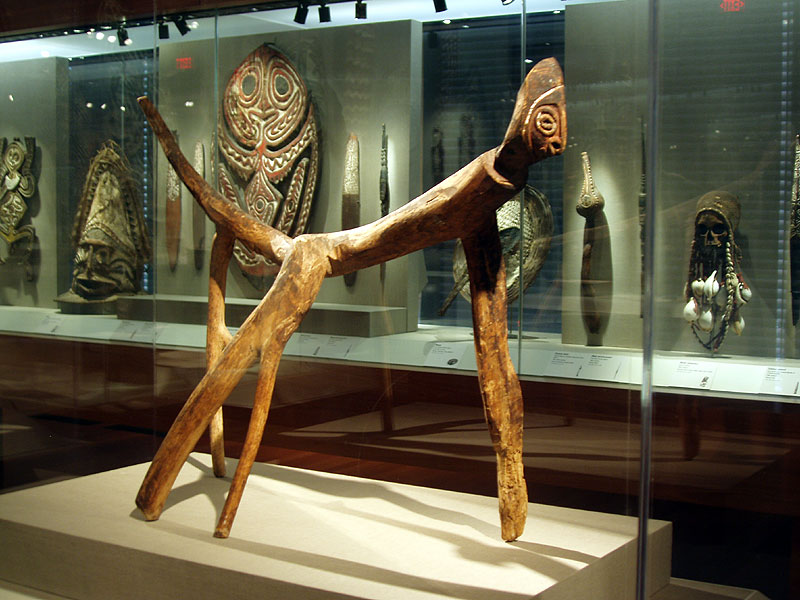
His "surrealist objects" often combine sticks, wood, or stone with biomorphic, amoeboid abstractions. It's interesting to compare the "Apple Monster", shown here, with the "Spirit Figure" in the de Young Museum's New Guinea collection.

This show also includes a sort of "curiosity cabinet", an alcove containing a selection of objects that he had in his studio, including a large thigh bone, a fish-shaped plate, and figurines.

For more information on Calder, see the Calder Foundation page.
A comprehensive catalog of his work: Alexander Calder, 1898-1976
Also recommended is the 1976 book Calder's Universe

Saturday, April 08, 2006

The new incarnation of the de Young Museum in San Francisco


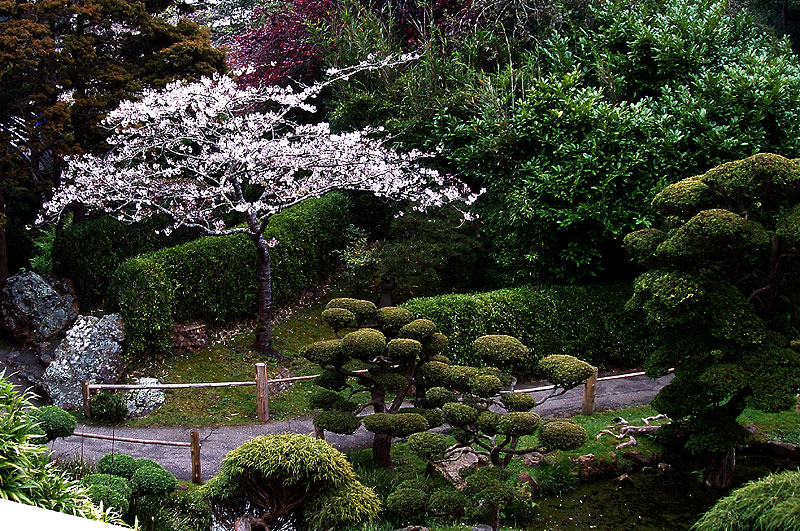
We headed up to Golden Gate Park to visit the de Young Museum last weekend. It was the latest in a long series of wet days. We stopped off first at the hundred-year-old Japanese Tea Garden next door. The cherry trees were blooming, the moss was thick and glistening in the rain, and the raindrops made rings in the ponds. The garden is a sublime example of creating art from nature. As you walk the paths, each turn creates a new picture, a composition of mossy rocks, water, pagodas, and plants, even incorporating the surrounding cypresses and pines. In contrast, the de Young museum is a brand new building, a completely rebuilt version of the old museum on the same site. The approach is along an unnecessarily narrow sidewalk hunched up against the external wall of the museum, which is a featureless monolith with no protective eaves. At the door, you are forced to stand in line in the rain to go through a security check. Once you are in, you can take a stairway down to the special exhibit area with steps which are too wide for a single step and too narrow for two so that you have to sort of limp your way down.

According to the museum's history page, the de Young, founded in 1895, was originally a curiosity cabinet of sorts, housed in an Egyptian style edifice.
During the next twenty years [de Young's] taste for the curious, intricate, and ornamental was reflected by acquisitions of painting and sculpture, arms and armor, fine porcelain, objects from South Pacific and American Indian cultures, including original art objects as well as reproductions. Visitors to the museum seem to have shared de Young's interest in such diverse objects as sculptures, polished tree slabs, paintings, a door reputedly from Newgate Prison, birds' eggs, handcuffs and thumbscrews, as well as two cases de Young had at last filled with a collection of knives and forks.

This ended in the 1930's:
[Longtime museum director] Dr. Heil chose to tactfully refuse personal keepsakes and household bric-a-brac, ending any perception of the de Young as the city's attic.
Pity. The city could use an attic!

In the early 1960's, the de Young decided to "de-accession" some of its holdings that were not part of its more modern focus on art, antiquities, and ethnographic artifacts. My dad, then a biology teacher at City College, was there, and picked up these two taxidermied birds, which are now part of the Zymoglyphic Museum's collection, creating a nostalgic link with museum history.

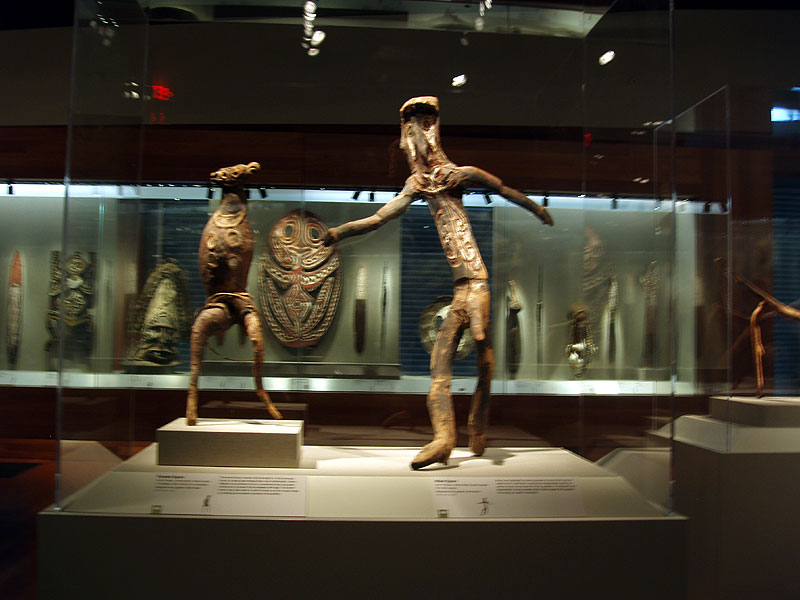
The evolution of the de Young is not all negative, however. It has always had an excellent collection of African, Oceanic, and Pre-Columbian artifacts and has recently acquired a large private collection of artifacts from New Guinea. This collection was the highlight of the trip. Shown here are "spirit figures" from Papua, dated at a few hundred years old. The label says:
Imunu are unique spirit figures obtained from the root of the Mangrove tree. A carver or spirit man dreams of an image and the goes to "find it" in the forest. A similar tradition is found among certain Inuit people, where the shaman dreams an image and then seeks it out among the driftwood on the beach

The collection is nicely documented in the book New Guinea Art: Masterpieces of the Jolika Collection from Marcia And John Friede

Sunday, April 02, 2006

Robert Hudson's Wild Constructions


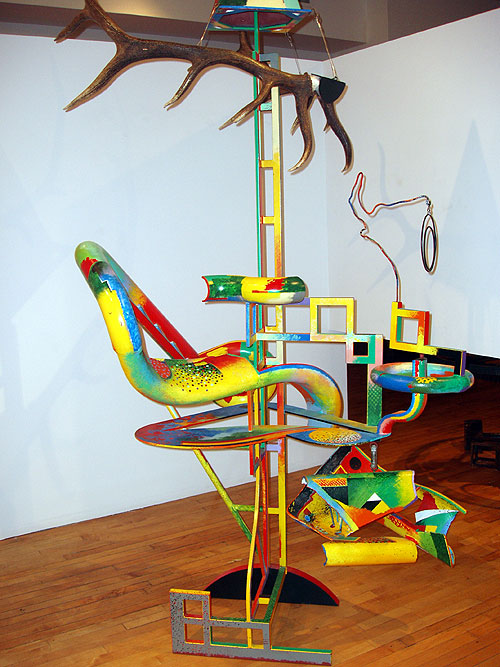
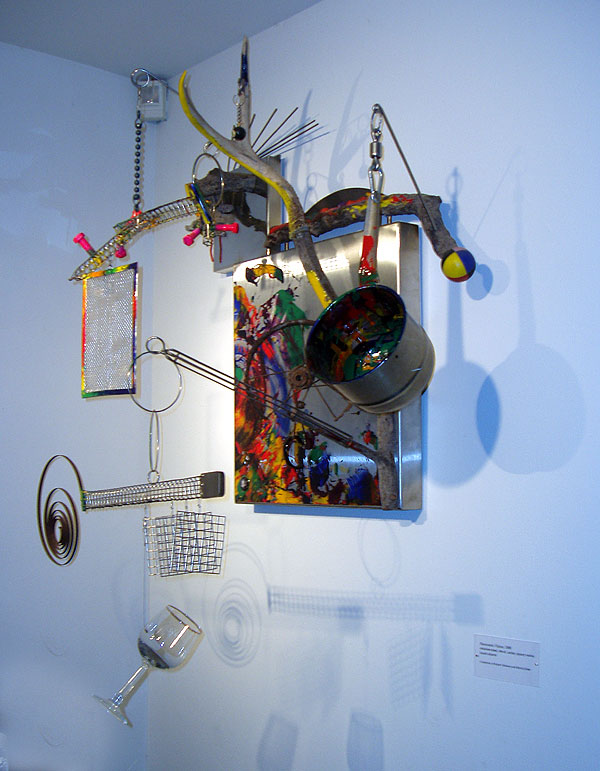
I took advantage last weekend of a rare sunny day to motor on up to the Sonoma County Museum in Santa Rosa for a retrospective of Robert Hudson's work. Hudson has been working in the Bay area since the 1960's, creating works that are a wildly improbable mix of elements - taxidermy, brightly colored paint, welded steel, furniture, geometric elements, farm tools, natural objects like sticks and antlers, ceramics that look like sticks and rocks, wire, rusty metal, pictures, and a variety of both unusual and ordinary found objects. Somehow it all works together in a way that creates a complex but balanced and unified object. To me it is a curiosity cabinet approach that ends up as a constructed sculpture, an integrated object instead of just a collection of objects.

Works shown are "Outrigger" (1984) and "Panoramic Vision" (1996). Hudson has only a scattered internet presence. The best reference for his work is the catalog of his 1985 retrospective at the San Francisco Museum of Modern Art: Robert Hudson: A Survey

Saturday, March 25, 2006

A Traveling Crustacean Mini-diorama

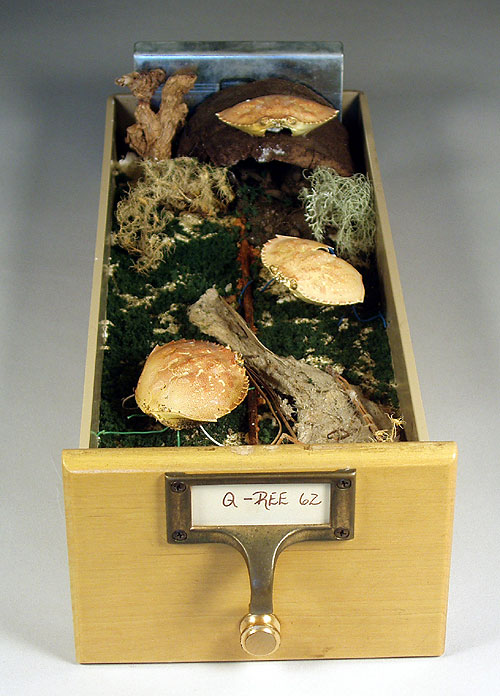
Last summer I was invited to participate in a project called The Curiosity Cabinet of the Collective Unconscious. The "cabinet" in question was an old library card catalog. Each participant got a drawer in which to create something having to do with the "collective unconscious". In mine, I ended up making a diorama featuring a little family of 3 crab carapaces in a wooded setting (shown here - click for larger view). I mostly work by just putting things together, often precariously, carrying them out to the museum, and possibly having to repair them when Open Studios rolls around. This was the first time that I had made something that needed to be shipped somewhere. The crabs had wires for legs, so they could be secured fairly easily, and the rest was glued or wired down. It was worth it to me to be part of a collaborative project, which was a welcome change for me.
The drawer had its debut with the rest of the cabinet at the Hive Gallery in August, which provided me with a good excuse to go down to L.A. for an extended weekend. The cabinet then traveled to Burning Man in September to become part of a funhouse that was installed in the base of the Man. The cabinet must have survived the inevitable fiery immolation of its host, as it has recently surfaced again at Create:Fixate in Los Angeles.

Saturday, March 18, 2006

Thong Controversy

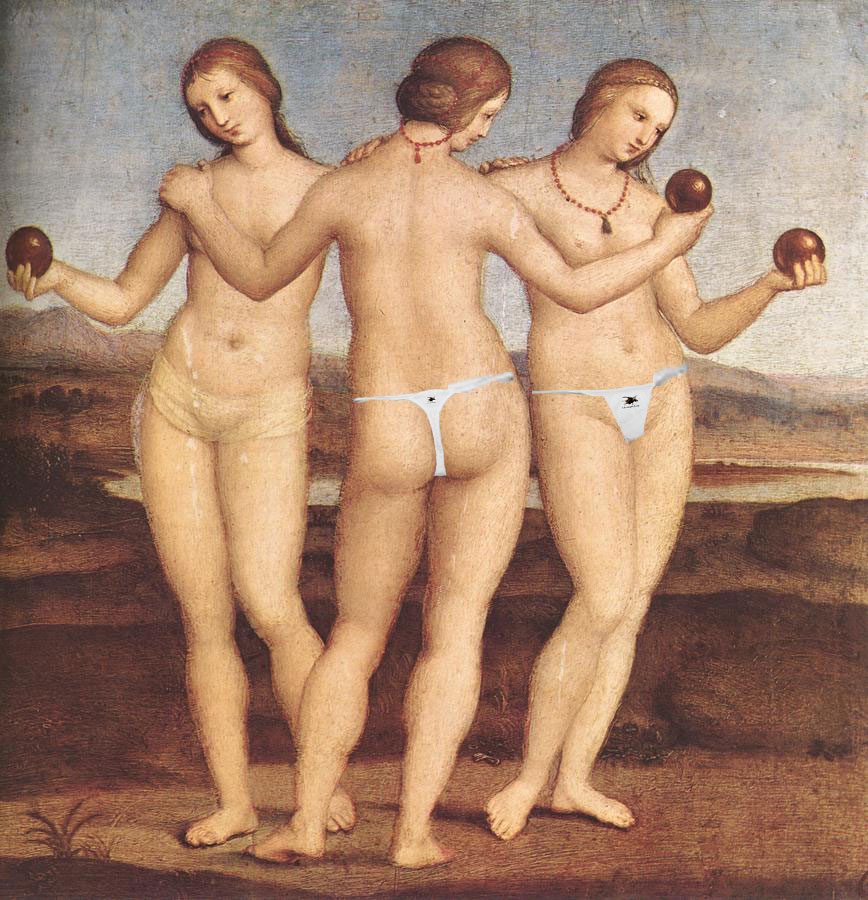
In a misguided attempt to "sex up" the museum shop's offerings and get sales moving from their current abysmal numbers, the museum's marketing department has decided to offer Zymoglyphic-branded thongs for sale. These items feature the same "flying-mummified-mouse" design which has proved so unpopular for the hats. This idea immediately ran into trouble with the Good Taste Review Board, which nixed the accompanying marketing campaign. However, the thong is still available for purchase. As a special treat for "behind-the-scenes" web log readers, the proposed campaign may be seen here. The models are "The Three Graces" by Raphael. The background image is taken from Wikipedia which states that the image may be "freely...exploited in any way by anyone for any purpose, commercial or non-commercial". We have taken "exploited" fairly literally here. Our spokesmodel Ileana, shown here, is not sure what to make of all this.

-- Museum Staff

Sunday, March 05, 2006

A Fantasy Museum Made Entirely of Words

While reminiscing about Ferdinand Cheval's "ideal palace" in the last entry, I was reminded of Steven Millhauser's story "The Barnum Museum", in the book by the same name. It is not so much a story as a 20-page description of a fantastic museum of the imagination. The scene is set:
The Barnum museum is located in the heart of our city, two blocks north of the financial district. The Romanesque and Gothic entranceways, the paired sphinxes and griffins, the gilded onion domes, the corbeled turrets and mansarded towers, the octagonal cupolas, the crestings and crenellations, all these compose an elusive design that seems calculated to lead the eye restlessly from point to point without permitting it to take in the whole. in fact the structure is so difficult to grasp that we cannot tell whether the Barnum Museum is a single complex building with numerous wings, annexes, additions, and extensions, or whether is it many buildings artfully connected by roofed walkways, stone bridges, flowering arbors, booth-lined arcades, colonnaded passageways.
He goes on to describe the rooms and the exhibits, the Hall of Mermaids, the three subterranean levels, the Chamber of False Things, and even rooms full of ordinary objects.
Even the gift shop is full of wonders:
Old sepia postcards of mermaids and sea dragons...mysterious rubber balls from Arabia that bounce once and remain suspended in the air...shiny red boxes that vanish in direct sunlight...Those who disapprove of the Barnum Museum do not spare the gift shops, which they say are dangerous. For they say it is here that the museum, which by its nature is contemptuous of our world, connects to that world by the act of buying and selling, and indeed insinuates itself into our lives by means of apparently innocent knickknacks carried off in the pockets of children.


Millhauser is one of my favorite writers, a wonderful blend of fantasy and literariness. His stories cover areas of interest to fans of the wondrous, such as automatons, illusionists, vast underground complexes, endless department stores, huge amusement parks, as well as vignettes of ordinary life.

In an interview, he says:
What interests me — not exclusively, but in relation to the monstrous — is the place where the familiar begins to turn strange. When things cease to be themselves, when they begin to turn into something else, which has no name — that is a region I'm always drawn to. This, I think, accounts for my interest in night scenes, in childhood, in bands of prowling adolescent girls, in underground and attic places, in obsession, in heightened states of awareness. In this sense, it might easily be argued that the wondrous and the monstrous are very much the same.

Ferdinand Cheval and Le Palais Ideal


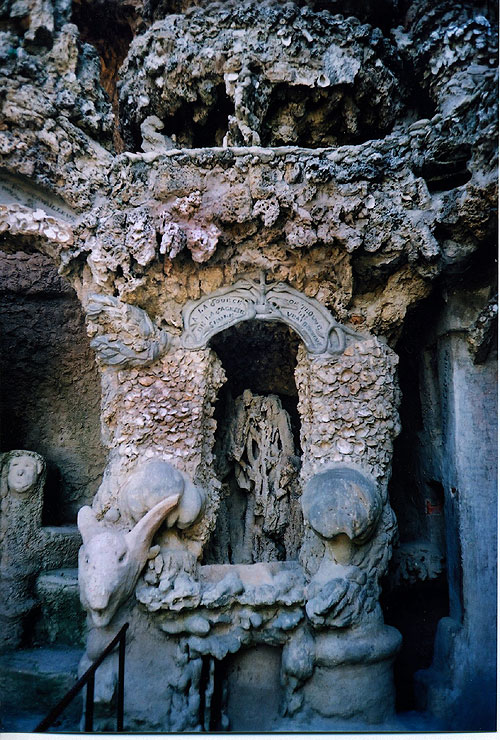
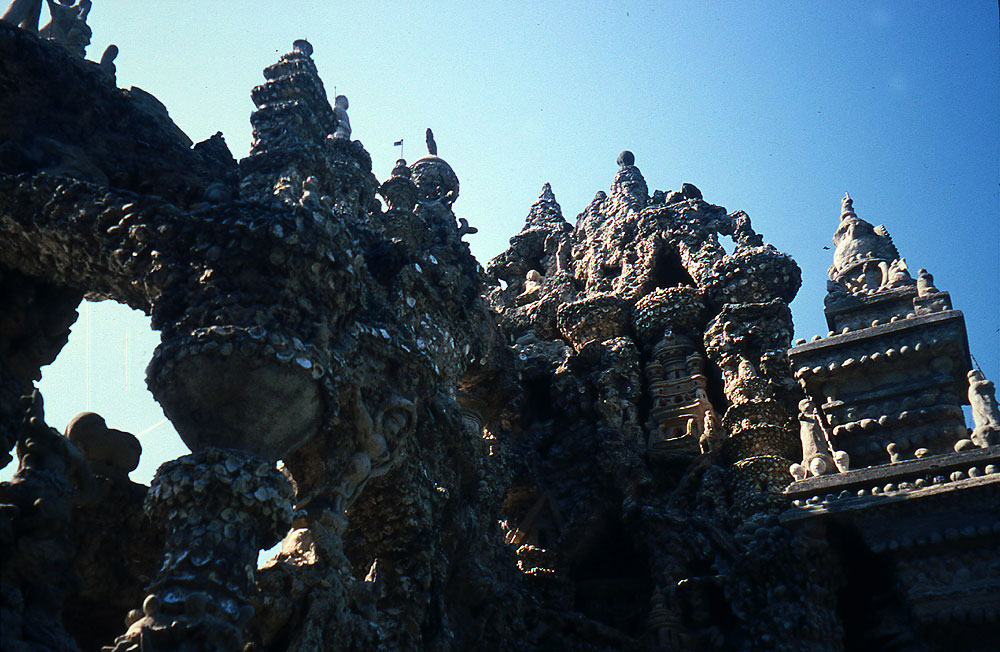
This entry was inspired by the Athanasius Kircher Society's "Visionary Architecture Week" and its coverage of the "Palais Ideal" in southeastern France. The palace was built by Ferdinand Cheval (1836-1924) over a period of some 33 years and it has been number one on my must-see list for many years. He built it using stones gathered on his rounds as a postman, as well as creating his own forms. I finally made a pilgrimage here in the fall of 2002. It is a wonder to behold. It contains a melange of architectural styles (real and imagined) with columns, arches, turrets, passageways, terraces, and giant statues. Inside and out are grottoes, galleries, rock gardens, and all manner of organic plant and animal creations emerging from it.

The Surrealists were fond of it, especially Andre Breton, who proclaimed Cheval as one of his own. Cheval has an entry in the Concise Encyclopedia of Surrealism which says, "The fantastic style of the palace...was often referred to by the Surrealists as an example of dream-life entering the real world."

A number of quotes from him were published in issue 38 of Raw Vision as an autobiography of sorts. He says:

I used to build a fairy-like palace [in my] imagination with all that the genius of a humble man could conceive (with grottoes, towers, gardens, castles, museums and sculptures) ...It so happened that just when my dream was gradually sinking in the mists of oblivion suddenly an incident brought it all back to me: I stumbled on a stone that nearly made me fall. I wanted to examine it closely, my stumbling block: its shape was so bizarre that I picked it up and took it away with me. The following day I went back to the same place and I found more beautiful stones which, gathered on the spot, looked so pretty and filled me with enthusiasm. Then I said to myself: ‘Since Nature provided me with sculptures I shall become an architect and a mason (besides who isn’t a bit of a mason?).'


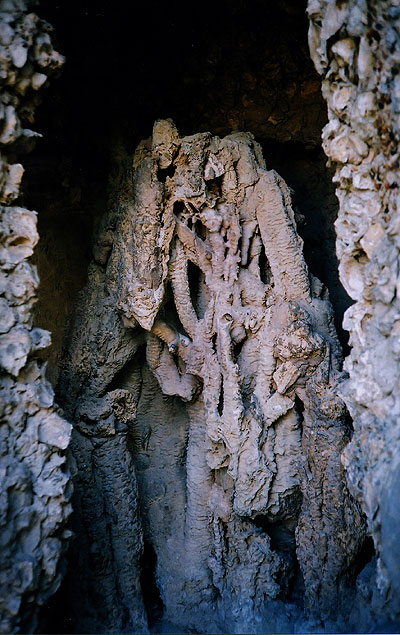
Among the many details of the palace, one aspect that was of particular interest to me was his display of interesting stones. The inspiring "stumbling block" he mentions can be seen here, perched on a pedestal on an upper terrace, just as any viewing stone might be. A particularly intricate and organic rock has been framed in its own grotto like a religious icon. Some of the rocks which he found contained fossils and other pictorial elements. They are on display together in another nook as the "Museum of Antediluvian Stones".

A comprehensive and well-illustrated documentation of the palace is
Le palais idéal du facteur Cheval: Quand le songe devient la réalité (Collection "Les Bâtisseurs inspirés") (text in French). This book may also be found at amazon.fr.
Photographs shown here by Jim Stewart, copyright 2002
For more photos, see here
For visiting information, see the official site