Saturday, February 10, 2007

Athanasius Kircher's Museum in Rome


Athanasius Kircher was a 17th century Jesuit scholar, and studied, among other things, magnetism (both physical and personal), linguistics (with a specialty in hieroglyphics and cryptography), vulcanology (most notably via an expedition into Vesuvius), and the customs of exotic lands such as China and America. Many of the theoretical conclusions from his voluminous researches did not survive the test of time, so the results of his investigations are valued today more for their mythic and inventive qualities than their scientific accuracy. Kircher was also an inventor, and created, designed or improved animated fountains, magic lanterns, talking statues, and elaborate optical and musical instruments.

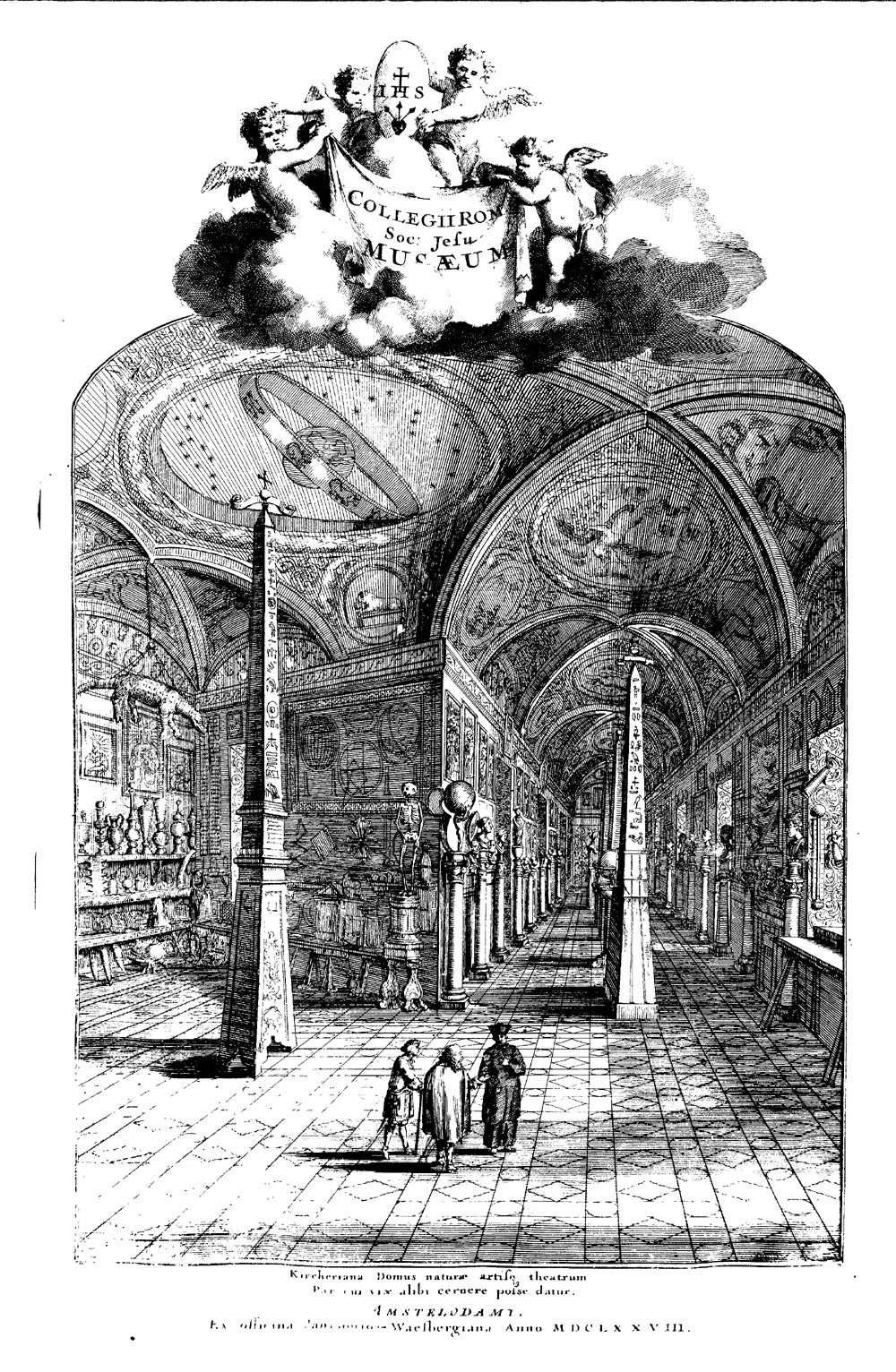
Kircher maintained a museum in Rome's Collegio Romano. The illustration above is from Giorgio de Sepibus's 1678 catalog of the museum. (click to see the full image). The museum contains the range of his interests: curiosities of nature, sculptures, Egyptian obelisks, and many of his mechanical marvels, all capped by a cosmic ceiling. Not shown in the images, but listed in the catalog, are a lizard encased in amber and a pair of creatures that were most likely the same species as the Zymoglyphic Museum's Jenny Haniver. The museum also included bound volumes of his correspondence, the 17th century equivalent of a curator's web log. His museum was really an extension of himself and went into decline soon after his death. The mechanical marvels stopped working and the more fanciful specimens disappeared. A catalog of the museum published in 1760, 80 years after his death, listed only antiquities.

I had not heard of him when I was younger, but I was afflicted with the same desire to know everything. I had a similarly wide range of interests: linguistics, cosmology, anthropology, biology. I ended up not going into science beacuse I could not specialize, and because science, broad as it was, still seemed too limited to physical reality, too literal, lacking in imagination. Perhaps creating a multi-faceted, personal museum has been the inevitable outcome.

The spirit of Father Kircher walks among us today in the form of the Secretary of the Athanasius Kircher Society. The society's Proceedings are daily writeups of the sorts of curiosities and esoterica that would have interested Kircher, and consistently the most interesting of the "oddities" blogs. The Proceedings have in the past year featured two of the Zymoglyphic Museum's collections, the Xenophora, shells that collect shells, and the miniature viewing stones. The Kircher Society recently has its first annual meeting in New York.

The Museum of Jurassic Technology in Los Angeles has an excellent exhibit on Kircher that reproduces many of his mechanical wonders.

The museum image above is from Stanford University's highly recommended Athanasius Kircher Project. Information about Kircher's museum is drawn from Paula Findlen's article "Science, History, and Erudition: Athanasius Kircher's Museum at the Collegio Romano" in The Great Art of Knowing: The Baroque Encyclopedia of Athanasius Kircher

Sunday, January 21, 2007

New Philatelic Wing Opens


The Zymoglyphic Museum is now in the process of putting its philatelic collection online. The first installment can be seen here.

"What attraction, dear reader, has a postage stamp for you?...Is it a symbol of ordinariness, or is it the ultimate within the bounds of possibility, the guarantee of unpasssable frontiers within which the world is enclosed once and for all?...A stamp album is a universal book, a compendium of knowledge about everything human. Naturally, only by allusion, implication, and hint. You need some perspicacity, some courage of the heart, some imagination in order to find the fiery thread that runs though the pages of the book."

From the story "Spring", in The Sanatorium under the Sign of the Hourglass by Bruno Schulz

My original museum, from when I was about 10 or 11, primarily included natural history objects, such as shells, rocks, and the occasional animal skin. However, like any decent curiosity cabinet, it also included cultural artifacts: arrowheads, kachina dolls, some square nails, and a worldwide stamp album. The stamps gave me a sense of connection to faraway, exotic places and collecting them created a sort of microcosm of the world. I was especially fascinated by the tiny, independent republics and principalities of Europe and idyllic scenes from isolated topical islands. The stamps of Africa and Oceania introduced me to romantic images of tribal art and lifestyles. My goal was to collect a stamp from every country in the world. I eventually lost interest in collecting stamps when exotic-sounding places like Bhutan, Tonga, and various Arabian sheikdoms started issuing gimmicky stamps which were clearly aimed at collectors and had no connection to their own cultures.

Later, in my forties, we inherited my wife's grandfather's collection of worldwide stamps. Judy had also been a collector as a girl, and it was something she and her grandfather would do together. While poring through this old album, I was inspired to start collecting again, taking up the task of collecting at least one stamp from every stamp-issuing entity. I spent a lot of pleasant weekend days hunting at local stamp shows and finding a stamp or two from some ever more obscure place. The total currently stands at more than 600 countries, territories, and other postal administrative units of the past and present.

Because of my interest in (and sympathy with) things that don't fall into standard categories, I became attracted to stamps known as "cinderellas" that were spurned by the mainstream collectors. These included stamps issued by independence movements in places such as Biafra and Chechnya, local postage from various British islands, and stamps produced by micronations. These have become the "exotic locales" of the modern world. Finally, I added the infinite and entirely imaginary geography of artist's stamps to my collecting. These can be any image in postage stamp size and style, but I have limited myself to ones purport to be from somewhere.

Sunday, January 07, 2007

Stalking the Wild Tafoni


The museum has recently mounted expeditions to find and document a rare natural art form known as "tafoni". Tafoni is a type of rock on which weathering has produced a zymoglyphic result. The rock results from a combination of tectonic activity and our Mediterranean climate. San Mateo is very close to the San Andreas Fault, where two of the earth's major tectonic plates grind together. Crossing the Crystal Springs Reservoir into the hills to the west takes you across the fault, from the North American Plate to the Pacific Plate. Over the millenia, the seismic ferment has caused ancient sea beds to be pushed upwards and become land. In some places, fossilized remnants of these sea beds are exposed as isolated knobs of sandstone.
Once exposed, the weathering begins. The rock absorbs water during our wet season, dissolving calcium from ancient bits of sea shells. During the dry season, the evaporation of the water draws the calcium to the surface, resulting in an uneven erosion of the remaining rock. The result is an evocative combination of sinewy fretwork and miniature troglodyte landscapes.

These rocks can be seen at the "Sandstone Formation" on the Tafoni Trail in El Corte de Madera Creek Open Space Preserve and a number of locations in Castle Rock State Park. More expedition photos, and a graphic showing how tafoni forms, can be seen here. Tafoni also forms in rocks along the local beaches and some excellent photos of it by tafoni aficionado Dawn Endico can be seen here.

Further details on rock formations in the Bay Area

Wednesday, December 27, 2006

The Cheese of the Month Club


The Zymoglyphic Museum's collections serve a variety of purposes. Its main holdings are the Zymoglyphic artifacts, which include among them the famous miniature viewing stone and Xenophora collections. Since collecting and arranging objects is an important aspect of Zymoglyphic culture, the museum maintains an auxiliary set of collections which reflect that spirit. One type of collection is the curiosity cabinet, in which a wide variety of natural and artificial wonders are gathered together. Another is the specialized collection, where a number of related objects are presented as variations on a theme. The museum's specialized collections now have their own exhibit space.

We have previously featured here the crab and happy object collections. In this entry we showcase the museum's unique Living Cheese collection. These are rare English cheeses which have been created using a special process which gives them each a unique personality. They are, from left to right, Swiss, Nacho, and Blue.

This collection was acquired via subscription to the Cheese of the Month Club, an exclusive group of which this museum was the only known member. Unfortunately, the subscription only lasted three issues, with a fourth installment being devoured enroute from London (see below). Fortunately, the museum considers three the minimum number of related items needed to qualify as a collection. The club's proprietor, Sarah Brunner, is now running the Otto Retro shop in Exeter, Devon.

Sunday, November 26, 2006

Rosamond Purcell's Art from Decay


Rosamond Purcell has a long history of providing inspiration to the Zymoglyphic Museum as a photographer of museum specimens, a scholar of curiosities, an exhibit curator, a writer, and an assemblage artist of decay. Her photographs of natural history museum specimens earned her a place in the museum's Photographers of the Marvelous online photography exhibit, and her use of natural light in these pictures has been an inspiration to our own curatorial department's attempts to document our museum's collections. One of her collaborations with Stephen Jay Gould, Finders, Keepers: Eight Collectors, includes the story of Peter the Great's Kunstkammer in 18th century Russia, and, in particular, his acquisition of Frederik Ruysch's collection of anatomical dioramas and other preparations. The book includes Purcell's photographs of some of the few remaining Ruysch objects . Further research on curiosities and marvels led her to write Special Cases: Natural Anomalies and Historical Monsters, examing the historical significance of marvels.

In 2003, Purcell curated a traveling exhibit called Two Rooms. One room was a reconstruction of a small but historically important natural history museum created in the 17th century by Ole Worm. The other room featured a reconstruction of Purcell's own studio/museum, with walls of rusted metal sheets, a library of decayed, worm-eaten books, and arrangements of a variety of objects transformed by nature and weathering. Most of these objects came from a single source, a vast junkyard in Maine which she has been mining for aesthetic gold for two decades, and whose story is told in the book Owls Head

Her new book Bookworm: The Art of Rosamond Purcell finally showcases her photographs of her own found and created decayed objects. The range is a mix of weathered objects and textures, photographic collages, and assemblages constructed for the purposes of the photograph. Shown above is "Book for Fishes", combining a fish skeleton with an old, insect-eaten book found in a Harvard library. For a preview of the book, see the slideshow/review at Slate.com


There seem to be still more Zymoglyphic inspirations which have yet be fully documented. Above are two photographs from "Two Rooms", the exhibition catalog. The top one is a "miniature museum" from 1994, similar in spirit to the Zymoglyphic shoebox art galleries and the bottom shows a number of objects on display in her studio, any of which would be at home in our museum.

Sunday, November 12, 2006

Only 312 days until Wacky Web Site Day!


Mark your calendars! Or if you buy the Wacky Web Sites Page-A-Day Calendar 2007, you won't have to, because Sept. 20, 2007 will already be marked as the day the Zymoglyphic Museum is the official Wacky Web Site of the day. This honor comes on the heels of the recent successes of the museum's marketing department's low-key strategy of basically not doing any marketing. The museum was recently listed on Neatorama, a site with some two million daily pageviews. It was suggested to them by Presurfer and picked up later by a number of other sites, including Monster Brains, NetKulture (sounds better in French!), and Grow-A-Brain (lumped in with Alzheimer's art and next to art made from dog food). A blogger known only as Jeff said "One of the neatest things I've ever seen. The Hallowed Pussy would feel right at home here." No idea what he meant by that, and the entry has since vanished.

The upshot was a multi-day spike in web traffic and an additional blog subscriber or two, bringing that count close to double digits. By the way, if you wish to subscribe to the blog via e-mail (not a bad idea considering how erratically it is updated) and don't know what RSS means, just send in your e-mail address and you can receive it that way. E-mail subscriptions come with the usual lifetime no-spam guarantee.

Now, our curatorial department might well prefer a grad student or two to write a scholarly treatise on the museum instead of the "wacky web site", or "zymo-what?", approach, but we will take what we can get. The museum has yet to find its Lawrence Weschler, who chronicled the Museum of Jurassic Technology. The Museum of Dust has come pretty close when not distracted by territorial spats and interplanetary intrigue. We and the MoD were featured recently on BlueTea's virtual museum tour, and this Live Journal entry was particularly endearing. We offered her a job, but she ultimately declined. Other blogosphere musings on the museum can be found here, here, and here.

Saturday, October 28, 2006

Fascinatin' Crustaceans


The Zymoglyphic Museum's Arthropod Division has recently expanded its Crabs of the World collection with a shipment from Conchology, Inc. of the Philippine Islands. The museum's original collection has been a miscellany of eBay, shell shop, and other purchases, not always with proper identification. A recent concerted effort for taxonomic accuracy in identifying its various specimens has been aided by a number of helpful folks at The Crustacean Society.

Crabs have an important place in Zymoglyphic culture. When dead, they often look as though they are just posing for a really long time, and so make excellent diorama characters. They are the stars in the traveling crustacean mini-diorama, as well as supporting actors in many of the museum's aquatic dioramas. They are nautical mechanical marvels, from the tight, interlocking parts of a box crab to the implausibly leggy spider crabs. Some, such as the fiddler crab, verge on becoming "eccentric contraptions", surreal beings whose very existence seems impossible. Some have great character, such as the leopard crab shown above.


In previous entries, we have featured as "natural assemblage artists" the bowerbirds, who collect and arrange various objects to attract mates, and the Xenophora, shellfish which collect and arrange other shells on themselves. Decorator crabs take the latter idea further and make themselves into living, walking gardens. They cover themselves with a selection of living seaweed and plant-like animals, such as sponges, corals, and bryozoans. This is not a weed garden in the sense of just allowing things to grow on the carapace; the selections are carefully nipped and placed on specialized projections on the shell. The purpose is both camouflage and protection due to the poisonous nature of many of the selections. The festively decked-out crab shown here is a Cyclocoeloma tuberculata (photo from edge-of-reef.com).

If you are in the Seattle area and interested in crustaceans, there is an excellent collection at the shell museum in Port Gamble, a ferry ride across Puget Sound from Seattle.

Sunday, October 22, 2006

Further Adventures of the Zymoglyphic Mermaids


Jenny Haniver and her cousin, the Zymoglyphic Mermaid, featured here recently, have been conscripted by the Museum of Dust to help out in Terra Incognita's impending war with the Republic of Tinselman. This so-called "republic" is actually run by a khan, or perhaps some other of the ever-changing panoply of tyrants and despots that seem to take turns ruling the place, with media magnate Rupert Murdoch apparently in on it too. Mermaids have historically played roles of destructive seduction, and our "paragons of pulchritude" (in our director's well-turned phrase), have been assigned to lead Mr. Murdoch astray. We have received news that Murdoch is now "fully occupied on the tiny islands off RoTs borders explaining cross-media ownership laws to the Zymoglyphic Mermaid and Jenny Hanniver". Tinselman appears at the moment to be coming unglued due to the extreme convolutions of its own plotlines, and may simply collapse of its own weight.

The Leatherwing, show above, is from the Zymoglyphic Museum's natural history collection. A more primitive relation of the Zymoglyphic Mermaid, it is a night-flying creature that may be useful for espionage and reconnaissance purposes. We will await word from Director de Plume on its mission.

On a taxonomic note, we must distinguish between the mermaids native to the Zymoglyphic region (order Rajiformes) and their distant cousins, the "Feejee mermaids". The latter are distinguished by a simian appearance in the upper body and a generally agonized facial expression (as opposed to the winning smiles on our own beauties). The "Feejee mermaids" originated in the waters of the western Pacific; that portion of their history is ably chronicled by Pink Tentacle. P.T. Barnum acquired one of these and made it famous. Due to the lack of genitalia (because of the lack of a crotch in which to contain them), there is some gender ambiguity, and they are also known as mermen. Modern specimens can be found here and here.

Sunday, October 15, 2006

From the Ancient Land of Happy Objects


A return trip to the de Young Museum in San Francisco turned up this fellow, a local emissary from Remojadas, the ancient Land of Happy Objects. Cheeky Pete was delighted to learn of this long-sought ur-object, the King of Happy Objects, but despite intense imaginary negotiations with the de Young curatorial staff, it was not possible for him to obtain the King for the museum's Happy Objects Collection. The King thus remains trapped in his plexiglass case. He is originally from the Veracruz area of Mexico, and is some 1300 years old. The Metropolitan Museum in New York has a cousin of his, and nervily suggests that his happiness is primarily due to intoxication.

The Remojadas culture had its "Classic" period between 500 and 800 AD, and produced a large number of "smiling figures". Further research by the curatorial staff has revealed the existence of a classic 1960 tome about the figurines produced in Remojadas: William Spratling's More human than divine: An intimate and lively self-portrait in clay of a smiling people from ancient Vera Cruz. Spratling was a collector, and waxes naively rhapsodic about the people who produced these figurines:
The little people of Remojadas flourished, loving their own creations, presumably in utter peace and contentment, for more than eight hundred years.

The main attraction of the book is the set of plates by Manuel Alvarez Bravo, a leading Mexican photographer often linked with the Surrealists. The photographs reveal that the figurines had a whole range of expression, not just smiling. The plates are classics of artifact photography.

Sunday, October 01, 2006

Notes from the Museum's Mermaid Tank


Mermaid collecting has had a rather difficult and controversial history. Mermaid collectors are often beguiled by artists' depictions of full-size, curvaceous, fish-women, but the actual specimens that show up in collections tend to be much shorter and not really all that human-looking. Some species seem to be a primate-fish mixture, with the type specimen generally regarded to be P.T. Barnum's Feejee Mermaid, exhibited at his American Museum. Modern versions can be seen here.

The Zymoglyphic Museum's new curiosity cabinet acquisition, shown above, belongs to a family of mermaids that has been referred to throughout history by the common name "Jenny Haniver".

This related species appears in Ulisse Aldrovandi's posthumously published 1642 work, Monstrorum historia


This sighting of a somewhat more primitive species is from Ambroise Pare's 1573 work, On Monsters and Marvels

This one appears in Mary Thompson's 1960 natural art classic, The Driftwood Book (photo by Leonid Skvirsky)


This specimen is from the 1975 catalog of the Wonders of the World Museum.

The Zymoglyphic museum's new acquisition joins two existing specimens in its natural history department. This one, referred to as the Zymoglyphic Mermaid, is endemic to the Zymoglyphic region. Also native to the region is a primitive flying species known as the Leatherwing.